38 Lighting Ideas for Mid-Century Modern Bedrooms with Red Accent Walls
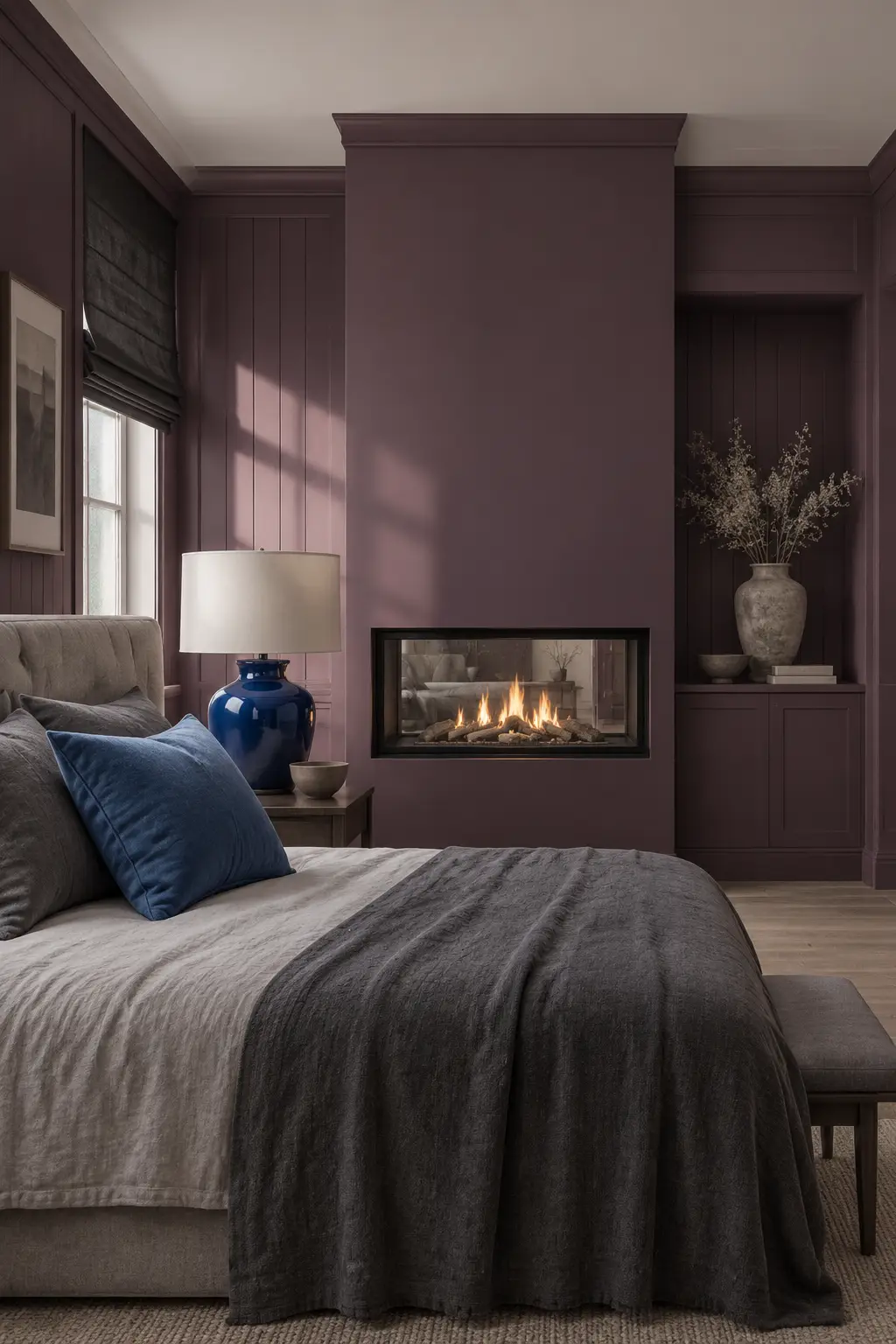
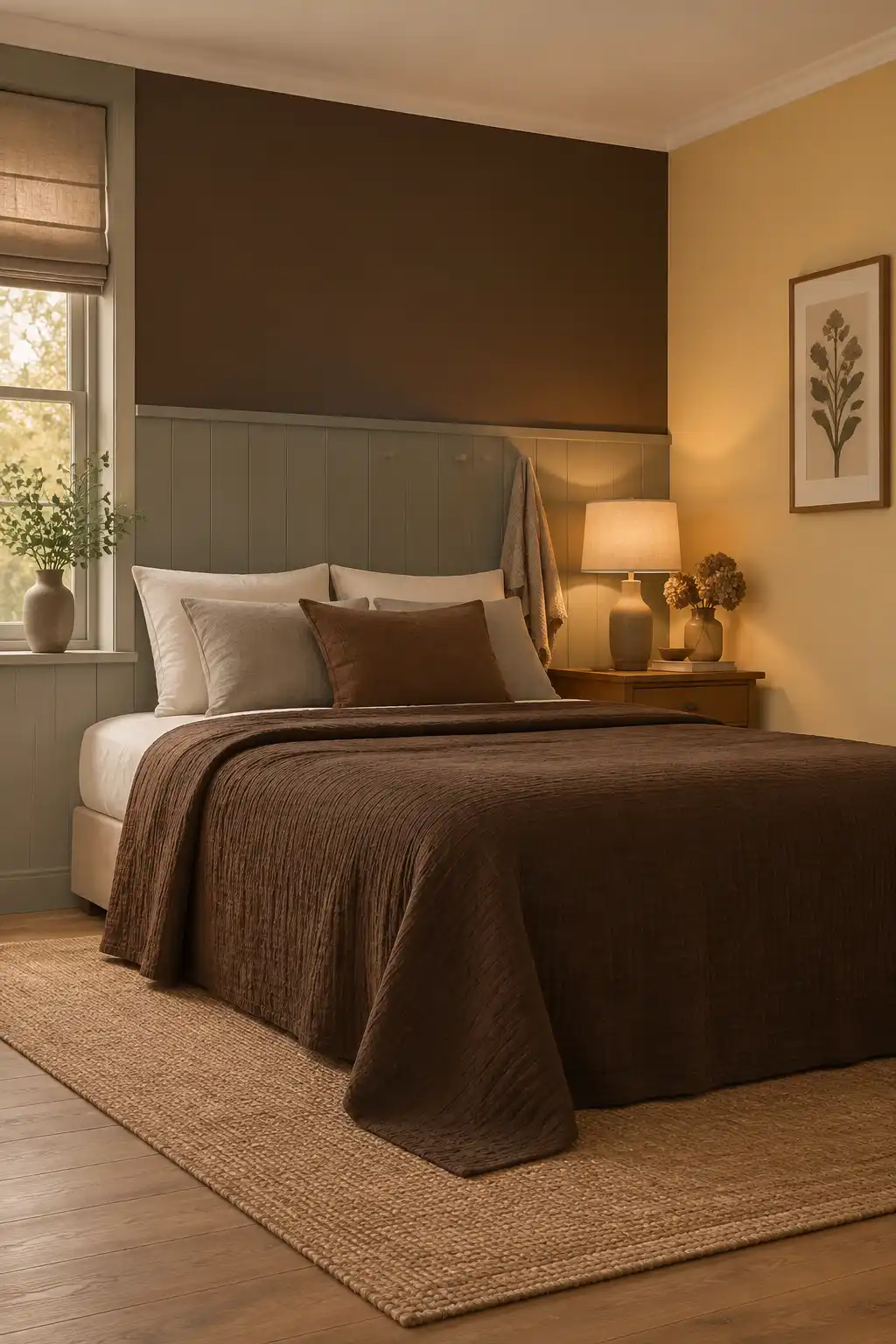
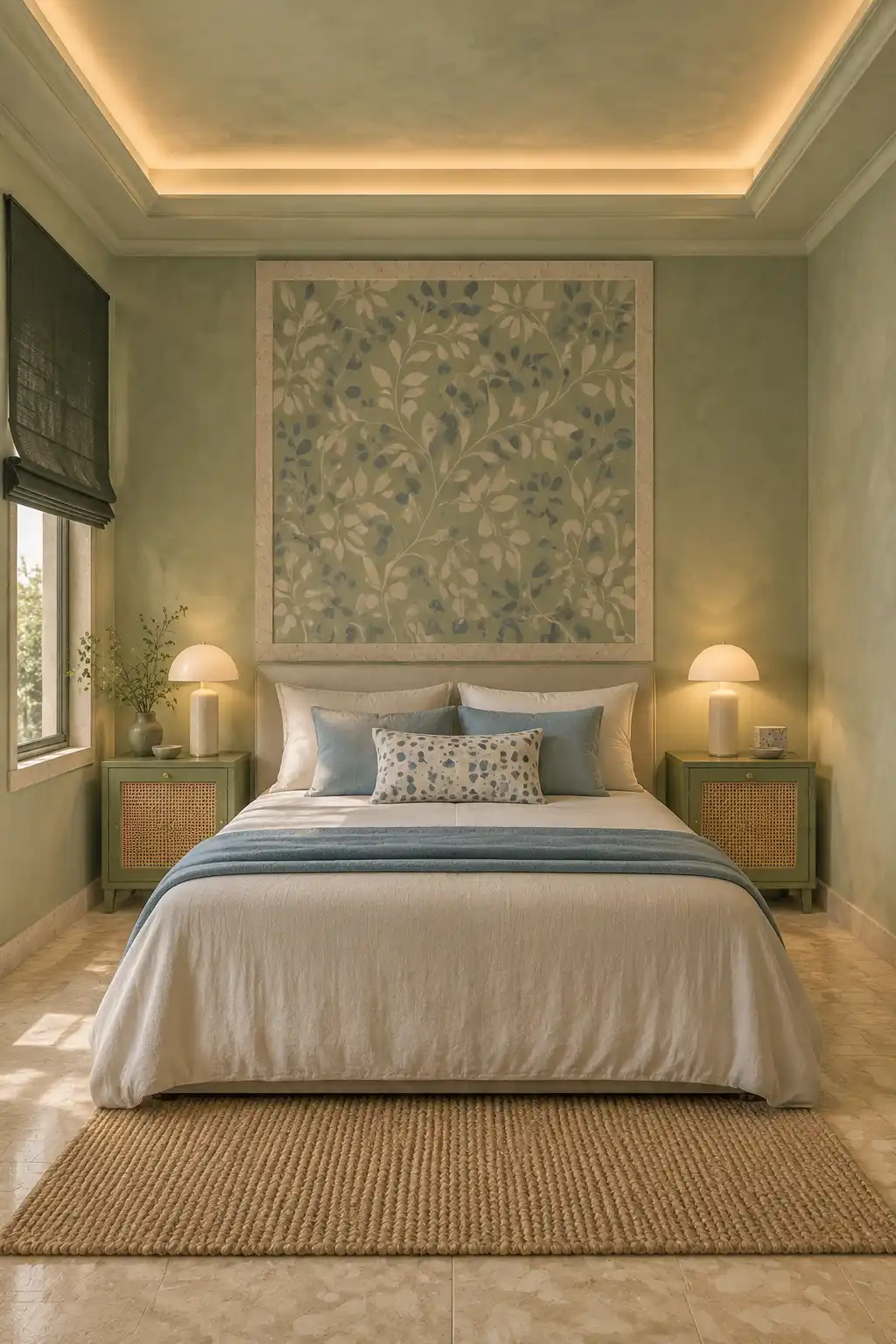
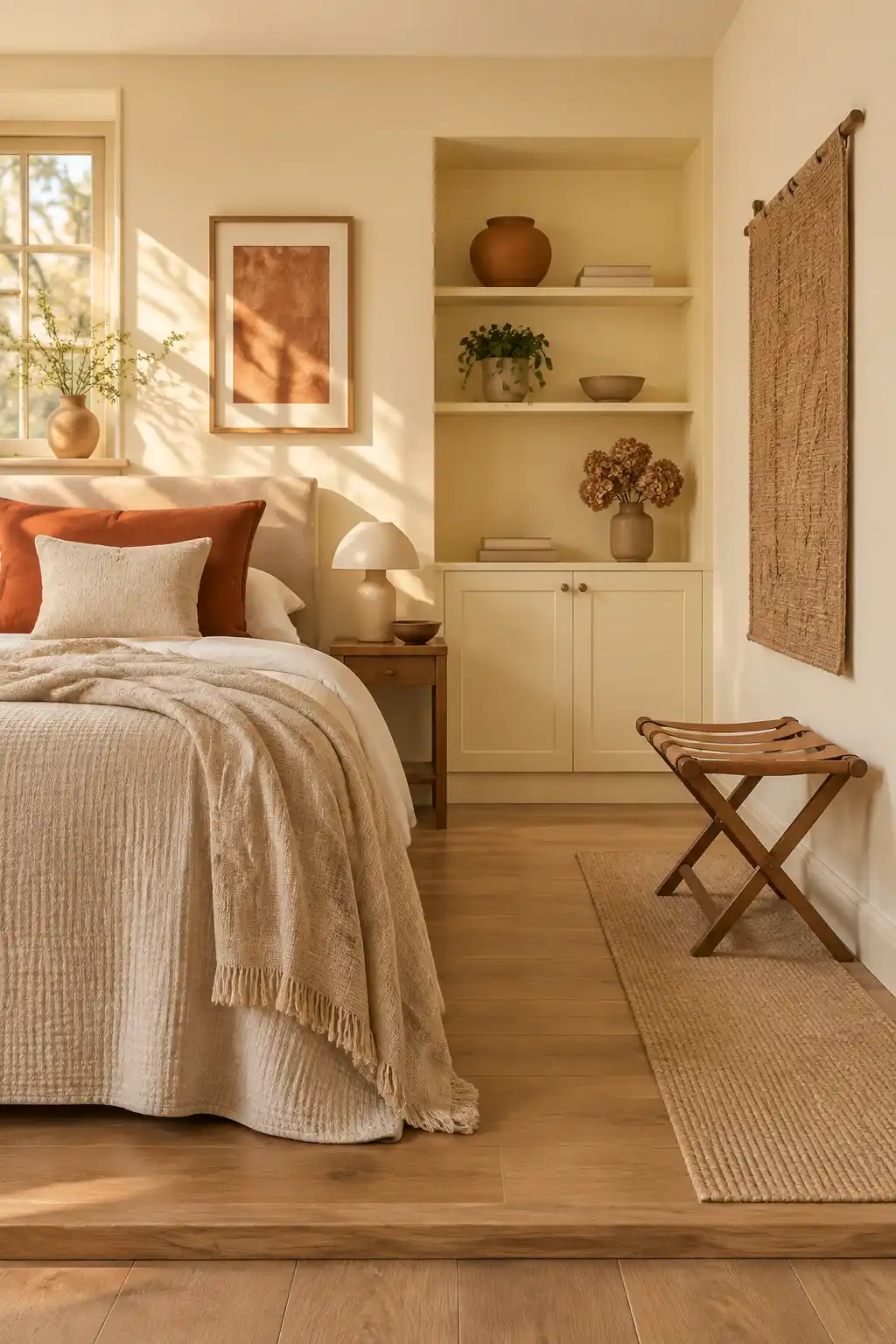
In a mid-century modern bedroom, a chimney breast on the bed wall with a single tall sash window is the part that cannot be restyled later. The midcentury register depends on a linen-covered headboard pad staying matte while a ceramic water carafe and a jute bedside runner stay small. Trace a walnut veneer headboard and a brick-red limewash wall from the first photograph to the last and the plan becomes obvious. One plain wall is kept free so the plan still works with a different bed. Below, 38 rooms show how far the mid-century modern rule can bend before it breaks.
1. Tonal Mid-Century Modern Walnut Veneer Headboard
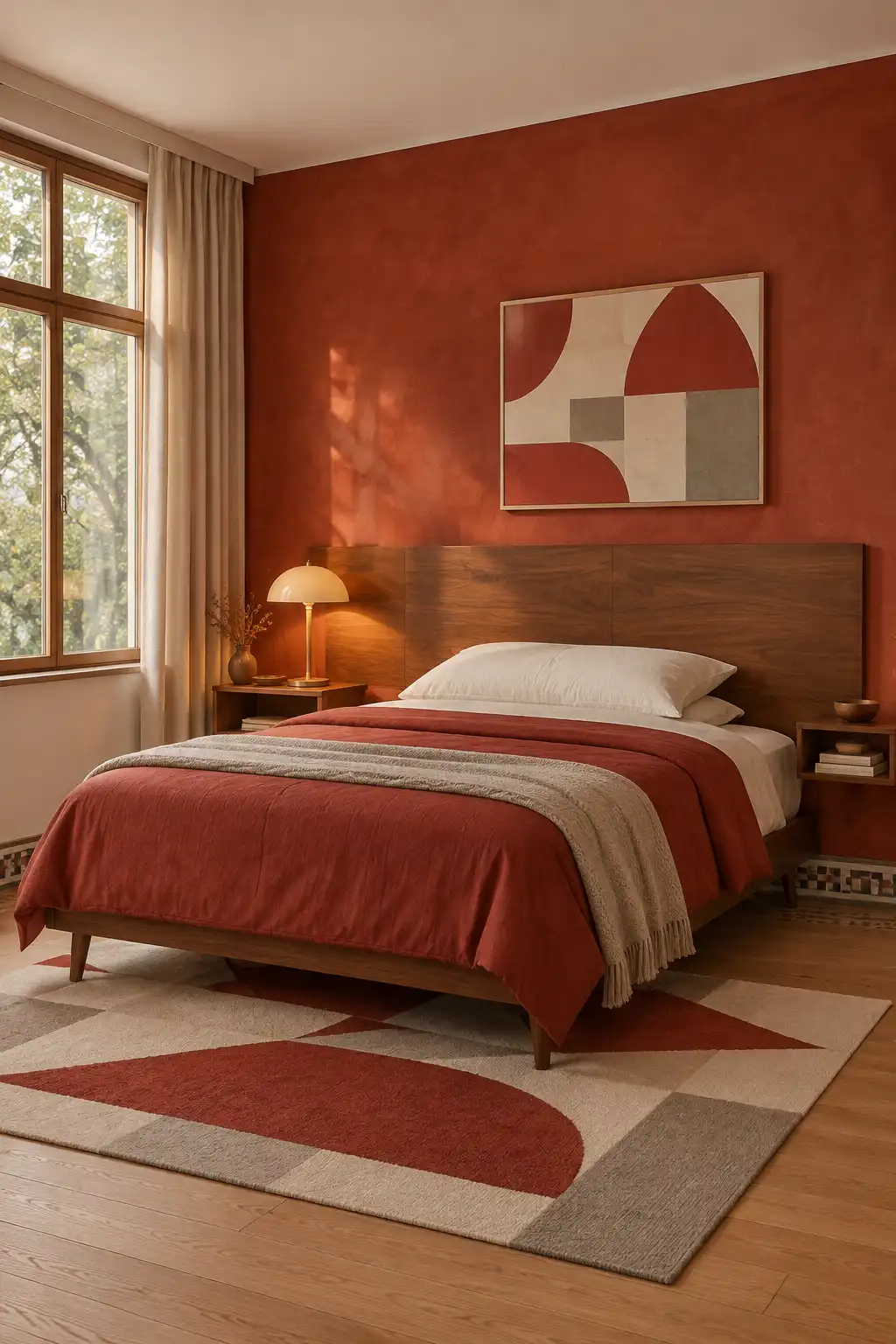
Tonal Mid-Century Modern Walnut Veneer Headboard photographs Mid-Century Modern as a midcentury arrangement of a walnut veneer headboard against chalk white. Fixed points here are a rust chalky plaster; a geometric wool rug, a painted door architrave, a walnut veneer headboard, a narrow timber shelf and a plain cotton pillowcase shift in weight from room to room. Adding another bedside table would break the balance. The Mid-Century Modern idea holds because a walnut veneer headboard is repeated at the same scale throughout. A second bedside table would crowd the arrangement without adding anything useful. It works as well in a rented room as in one you own, since the fixed details are few.
2. Tonal Mid-Century Modern Globe Pendant Corner
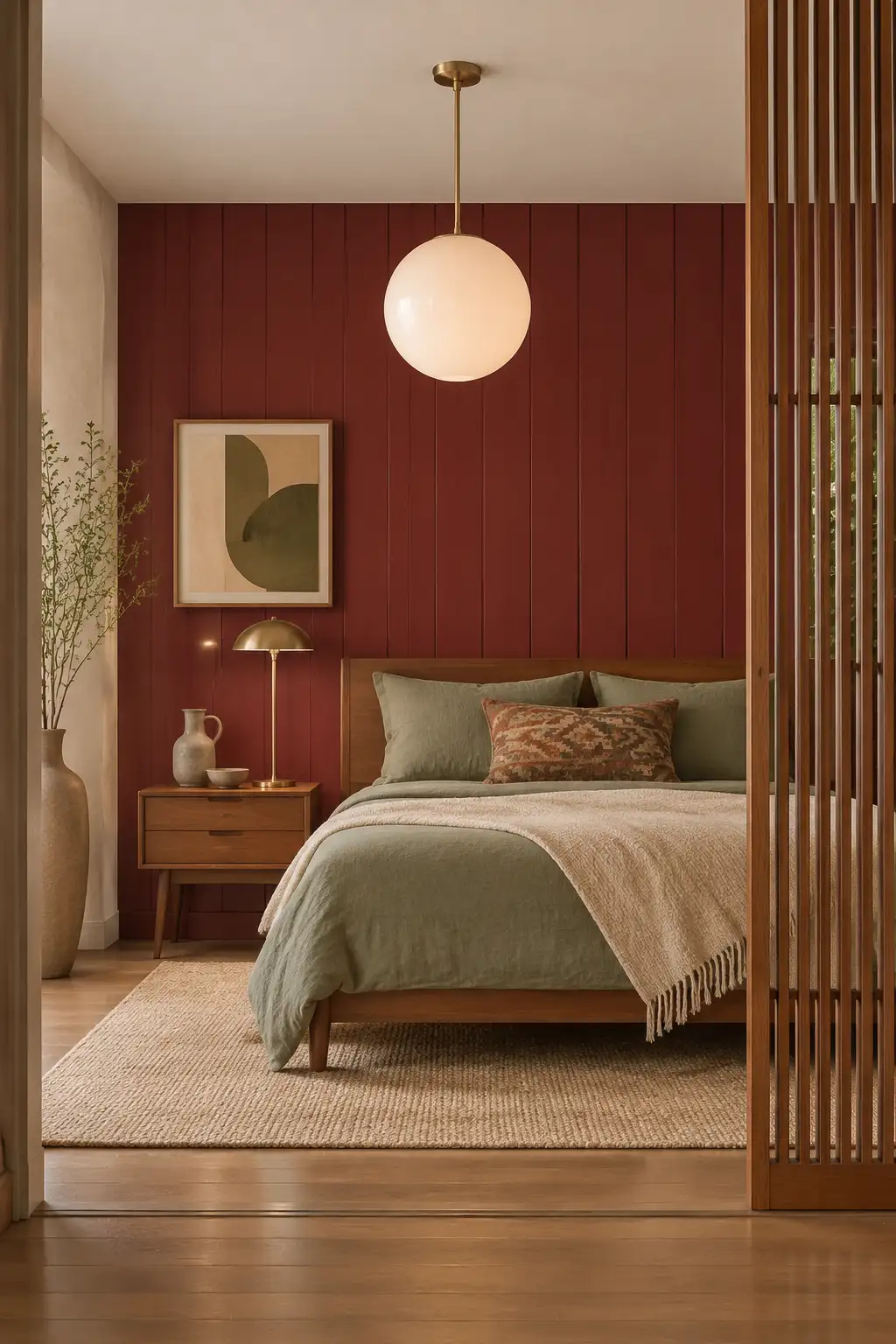
Tonal Mid-Century Modern Globe Pendant Corner keeps the Mid-Century Modern proportion steady by repeating a globe pendant and limiting muted sage. Every frame shows a deep red panelling, with a muted kilim cushion and a squat stoneware carafe softening the harder a teak slatted screen, a plain ceiling line, a globe pendant. Adding another bedside table would break the balance. The Mid-Century Modern shell stays legible because a globe pendant is kept lower than the frame suggests. A house with children would swap the soft items and keep everything else. A taller window would change the light but not the position of the furniture.
3. Quiet Mid-Century Modern Slim Tapered Legs
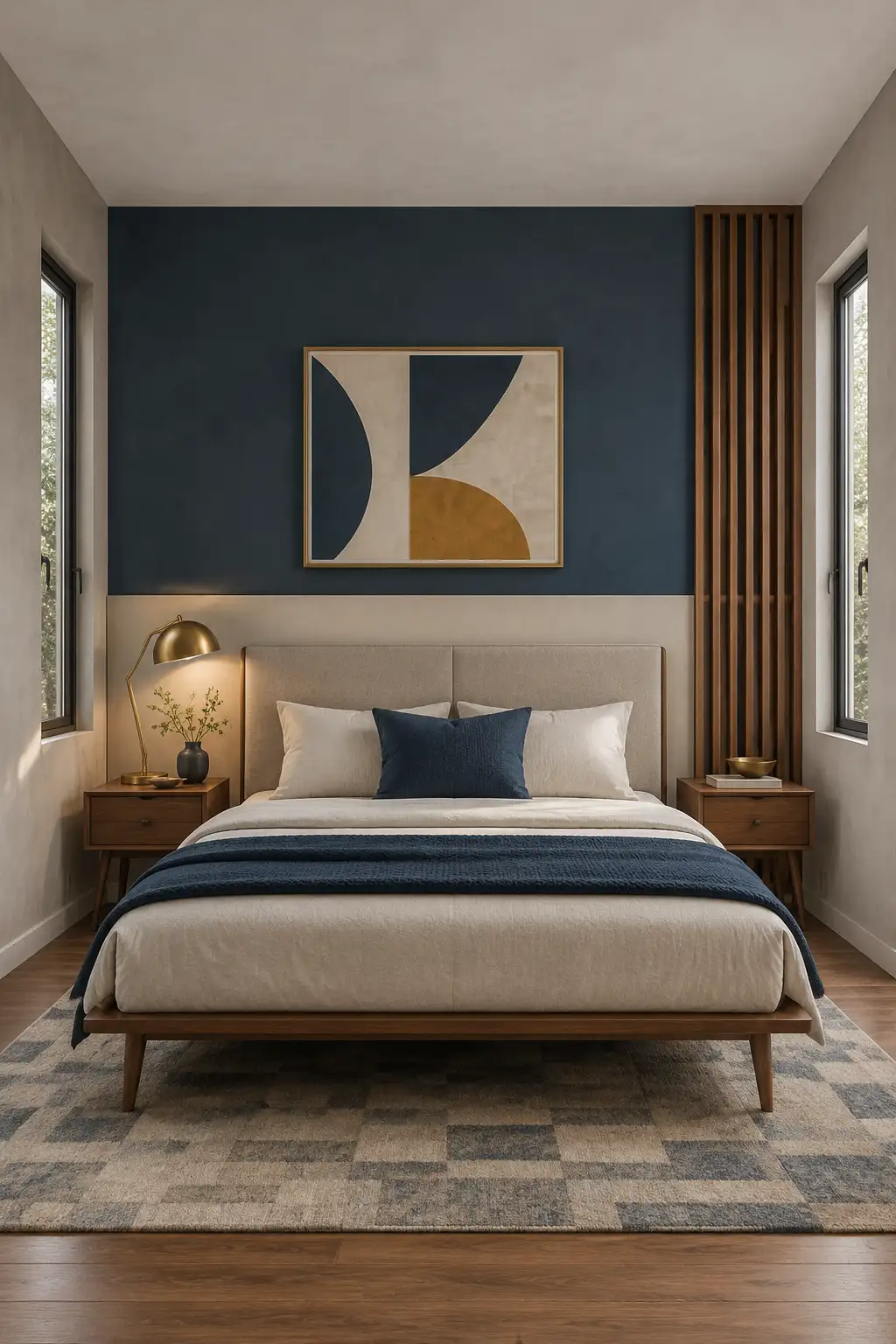
The Mid-Century Modern proportion in Quiet Mid-Century Modern Slim Tapered Legs is set by slim tapered legs, with deep navy kept to the soft items. A teak slatted partition, a colour-blocked headboard wall, slim tapered legs does the structural work, with a matte wall finish holding the midcentury reading steady beside a linen-covered headboard pad. The treatment suits both daily use and occasional guests. The Mid-Century Modern shell needs only slim tapered legs and grey daylight from two slim casements to read as midcentury. The clear wall beside the bed doubles as the route to the window.
4. Quiet Mid-Century Modern Geometric Wool Rug
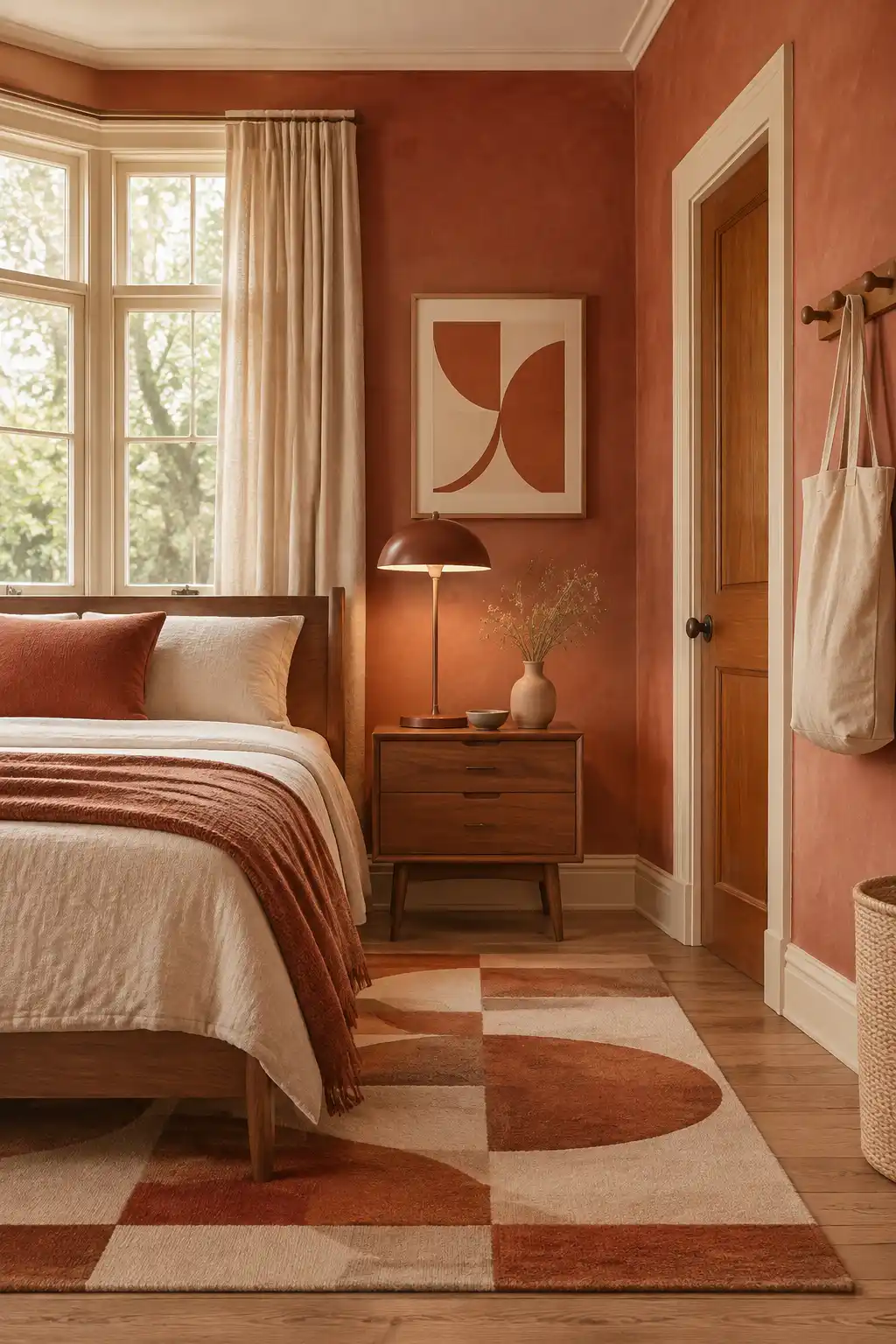
In Quiet Mid-Century Modern Geometric Wool Rug the Mid-Century Modern character comes from the junction of a geometric wool rug and terracotta. Look first at a painted door architrave: a canvas laundry bag and a walnut veneer door, a brick-red limewash wall, a geometric wool rug then explain why the midcentury scheme holds together. The treatment suits both daily use and occasional guests. What bright side light from a bay window reveals is a geometric wool rug, and that is where the midcentury Mid-Century Modern argument ends. The Mid-Century Modern decision is permanent; the textiles around it are not.
5. Quiet Mid-Century Modern Teak Slatted Screen Passage
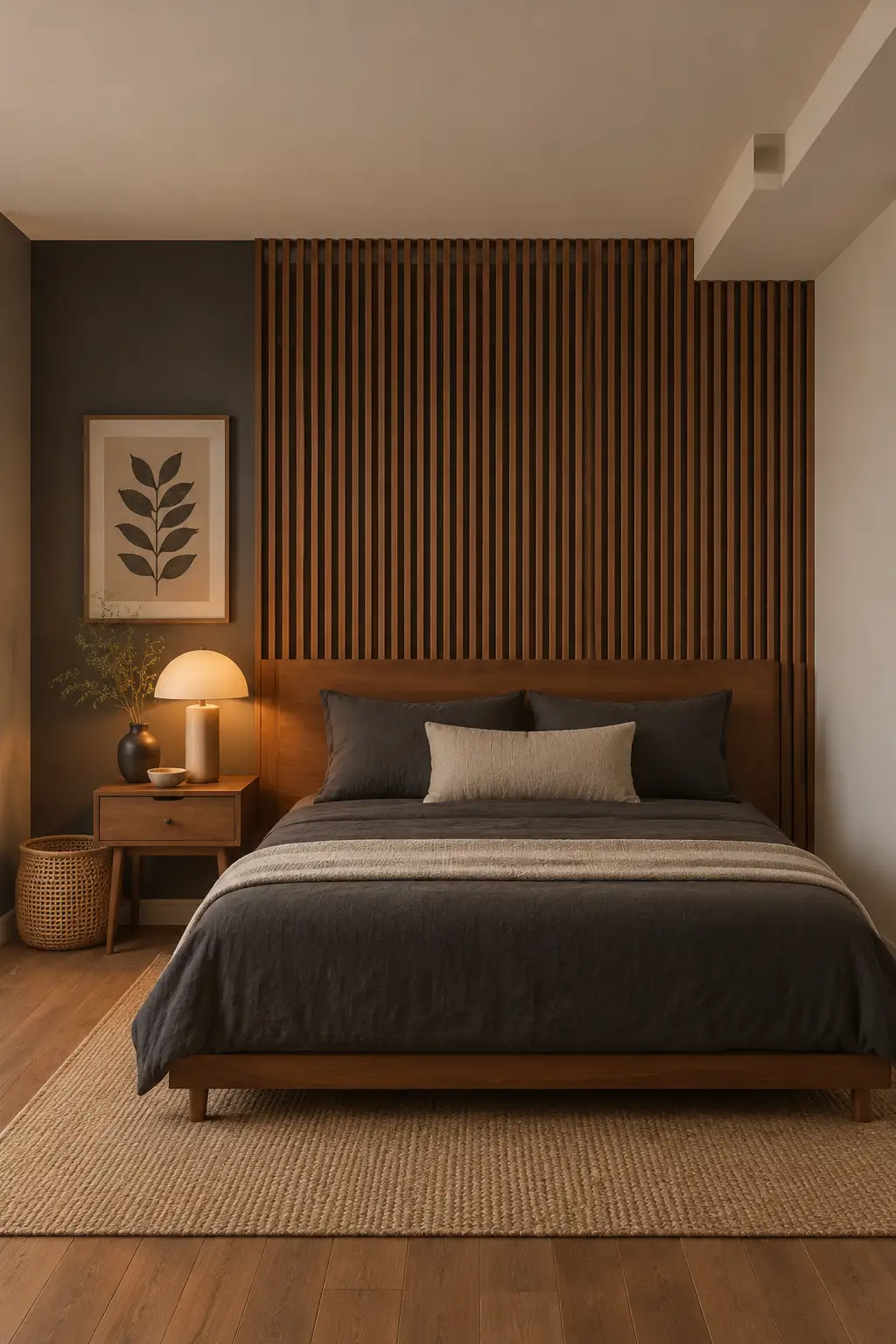
Quiet Mid-Century Modern Teak Slatted Screen Passage presents Mid-Century Modern at full scale in a midcentury bedroom, with a teak slatted screen and charcoal setting the finish. The midcentury register comes from a plain ceiling line, with a framed botanical print and a cane bedside basket kept deliberately quiet against a stepped ceiling detail, an oxblood painted alcove, a teak slatted screen. The treatment suits both daily use and occasional guests. A teak slatted screen under low evening light from a shaded bedside lamp is what keeps this midcentury Mid-Century Modern room from feeling staged. The scheme stays easy to live with, needing nothing more than a dimmable bedside light after dark.
6. Layered Mid-Century Modern Teak Slatted Partition
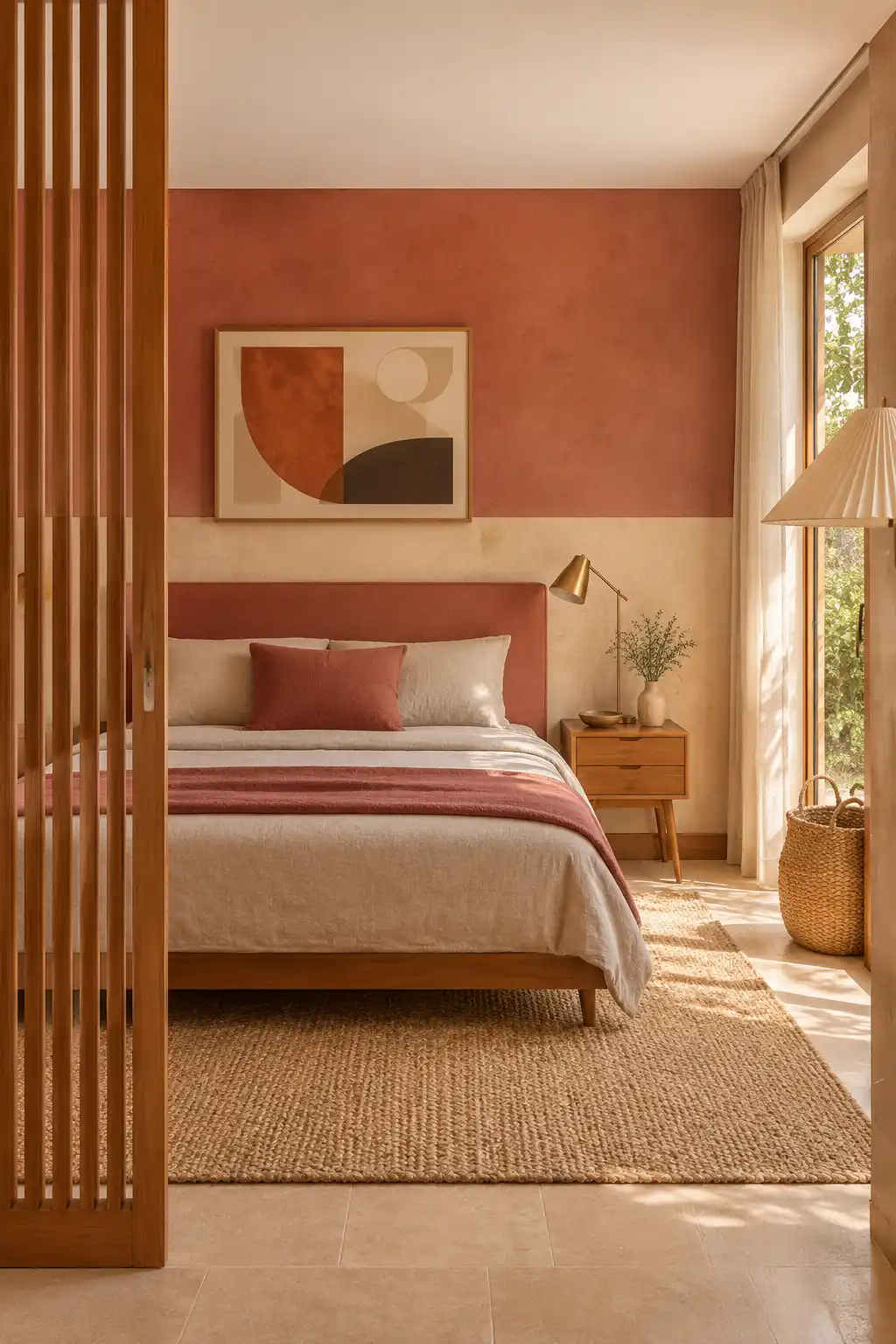
At this scale Layered Mid-Century Modern Teak Slatted Partition reads Mid-Century Modern through a teak slatted partition before dusty rose registers at all. Across this set the fixed pieces stay constant: a colour-blocked headboard wall, while a tapered timber skirting, a rust chalky plaster, a teak slatted partition, a woven seagrass basket and a pleated shade vary in finish. The treatment suits both daily use and occasional guests. The Mid-Century Modern proportion is easiest to read where a teak slatted partition meets bright morning sun from a garden door. One plain wall is left empty so the room can take a different bed later.
7. Layered Mid-Century Modern Walnut Veneer Door
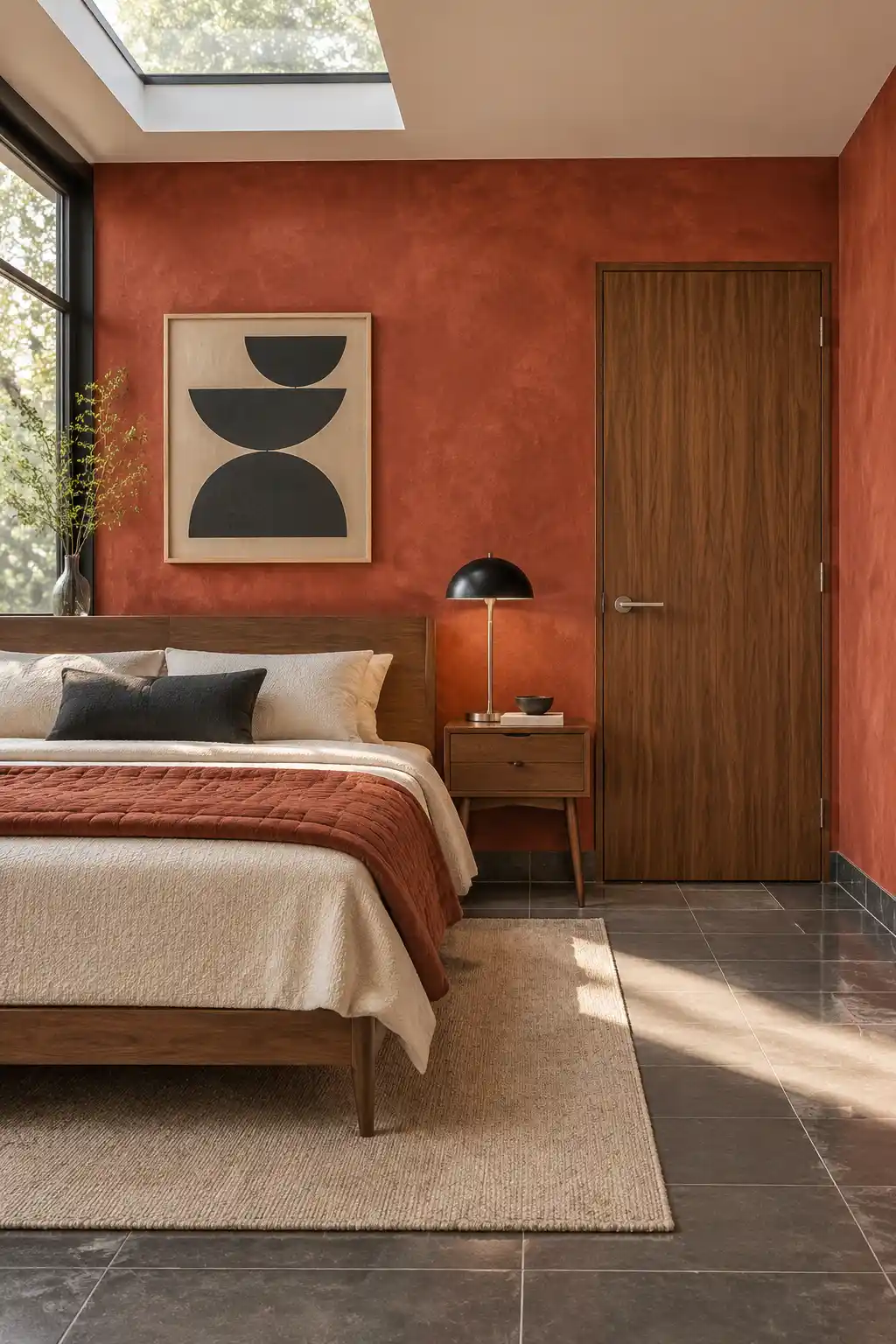
Layered Mid-Century Modern Walnut Veneer Door records Mid-Century Modern as a midcentury bedroom reduced to a walnut veneer door, with ink black left as the only tone. In each room the eye lands on a brick-red limewash wall before it reaches a folded cotton quilt, a cream wool bedspread or a tapered walnut bed frame, a deep red panelling, a walnut veneer door behind them. The treatment suits both daily use and occasional guests. Read a walnut veneer door against midday sun from a rooflight and the Mid-Century Modern midcentury plan becomes obvious. The plan leaves enough space to open a wardrobe door fully.
8. Layered Mid-Century Modern Stepped Ceiling Detail Composition
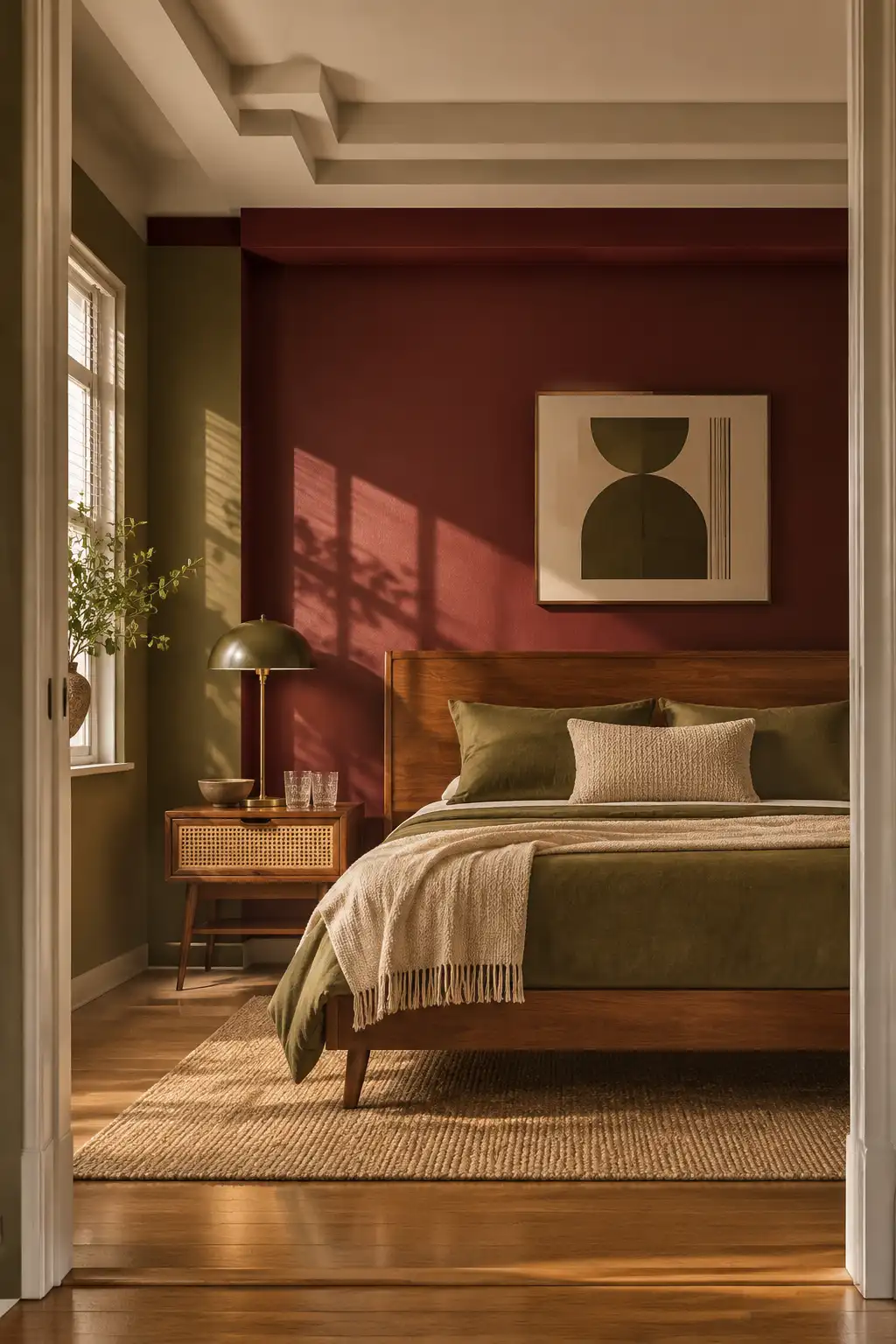
What Layered Mid-Century Modern Stepped Ceiling Detail Composition isolates is the Mid-Century Modern shell: a stepped ceiling detail, a little sand, and very little else. The composition is anchored by an oxblood painted alcove; a walnut veneer headboard, a matte wall finish, a stepped ceiling detail sets the depth and a low ceramic bowl supplies the only soft edge. The treatment suits both daily use and occasional guests. Under low sun from an east window the midcentury palette stays secondary to a stepped ceiling detail and the Mid-Century Modern outline. The same pieces can be moved one room over and still read correctly.
9. Pale Mid-Century Modern Tapered Timber Skirting
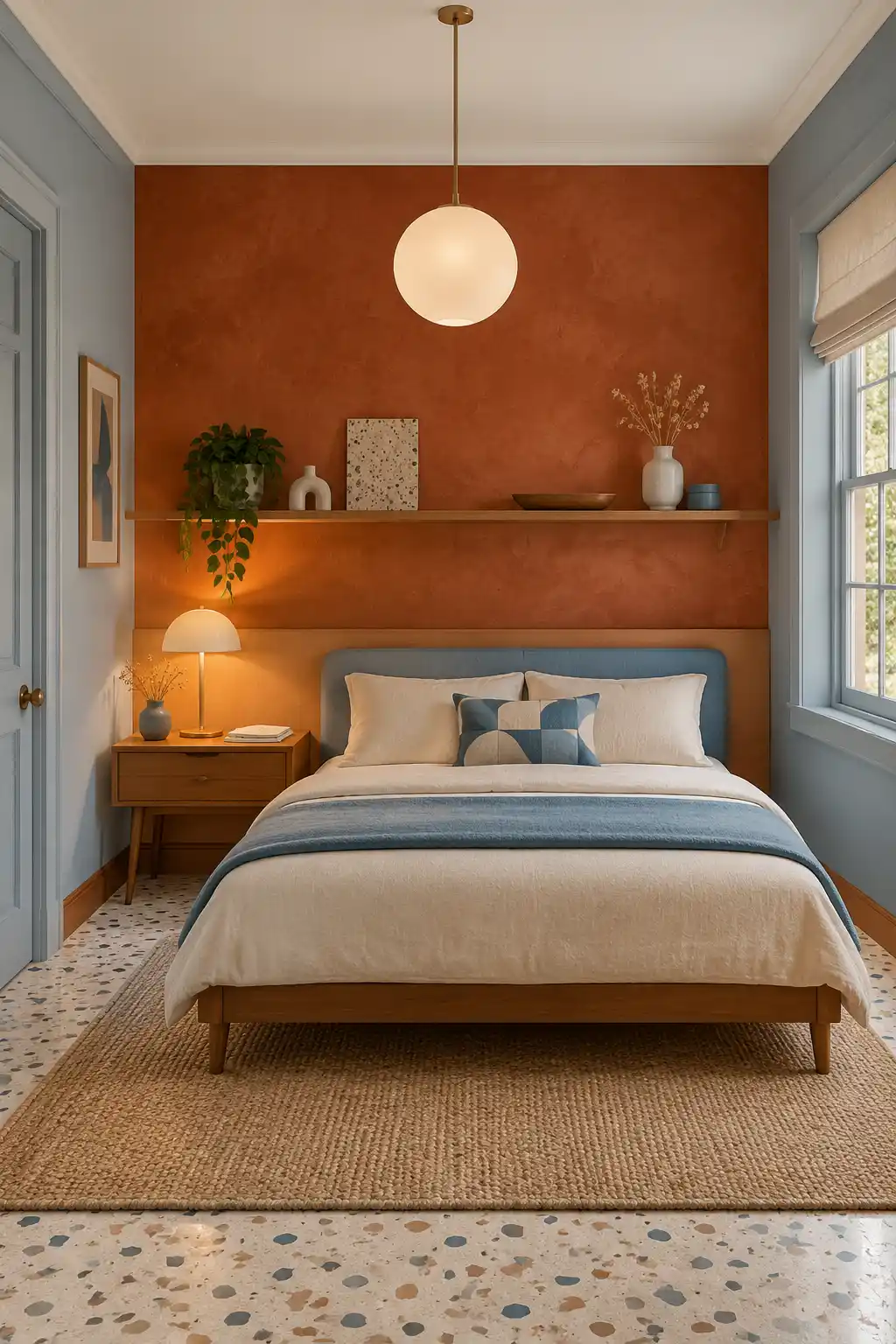
The fixed a tapered timber skirting in Pale Mid-Century Modern Tapered Timber Skirting gives this midcentury Mid-Century Modern room its scale, not powder blue. There is no styling trick here: the plan relies on a rust chalky plaster to stay midcentury beside a wide shallow tray. The treatment suits both daily use and occasional guests. With a low lamp beside the bed held steady, a tapered timber skirting carries the midcentury finish without disturbing the Mid-Century Modern plan. A narrow room and a wider double can share the plan, with only the rug size changing.
10. Pale Mid-Century Modern Tapered Walnut Bed
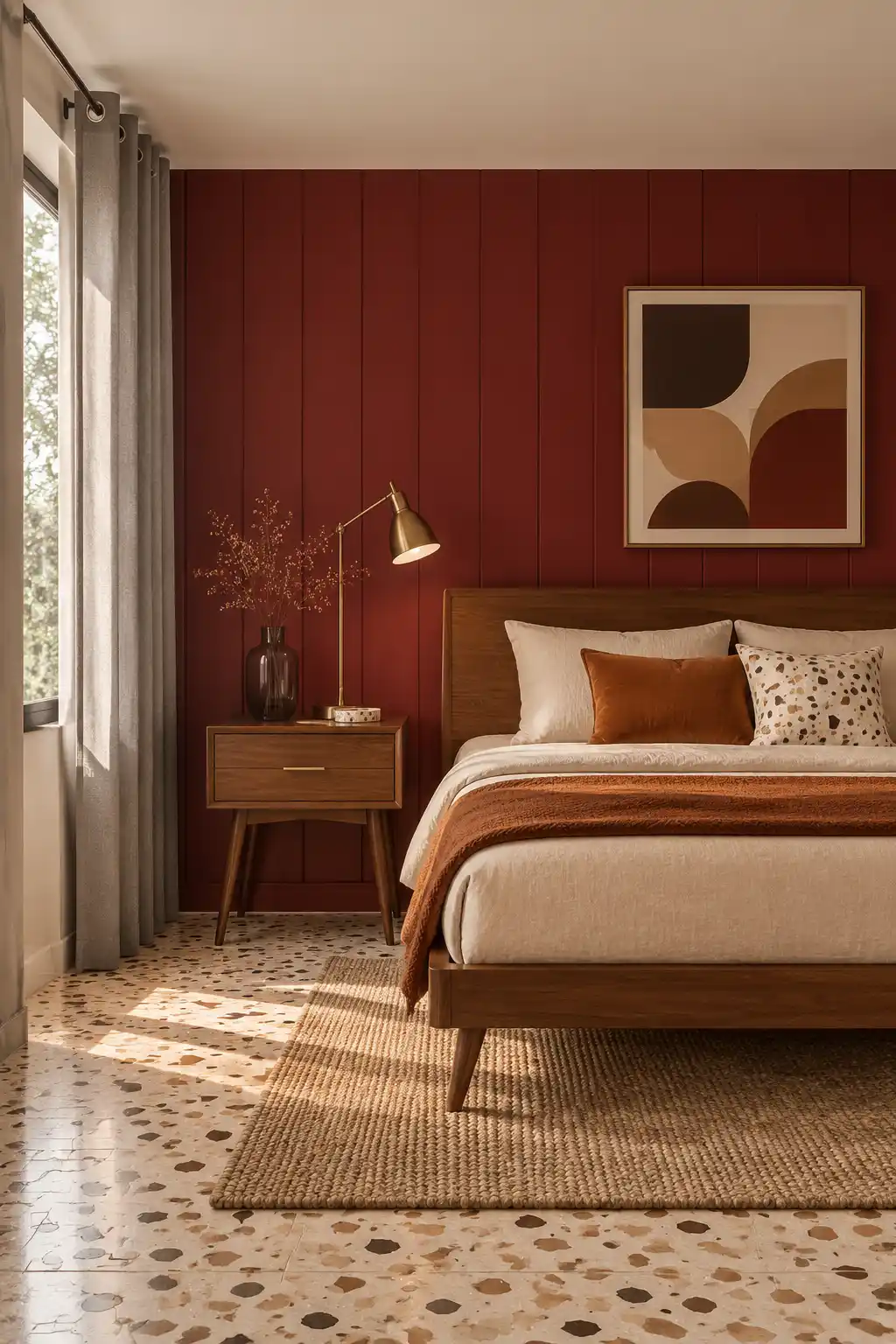
Pale Mid-Century Modern Tapered Walnut Bed is a midcentury study of Mid-Century Modern, with a tapered walnut bed frame doing the structural work and cognac staying quiet. The camera keeps returning to a deep red panelling, with slim tapered legs, a plain ceiling line, a tapered walnut bed frame and a soft grey eyelet curtain held at the same scale throughout. A single wall stays bare by design. At the edge of the frame a tapered walnut bed frame and early light from the doorway side settle the Mid-Century Modern proportion. The palette survives a change of bedding, which is the only part that needs washing.
11. Pale Mid-Century Modern Walnut Veneer Headboard Nook
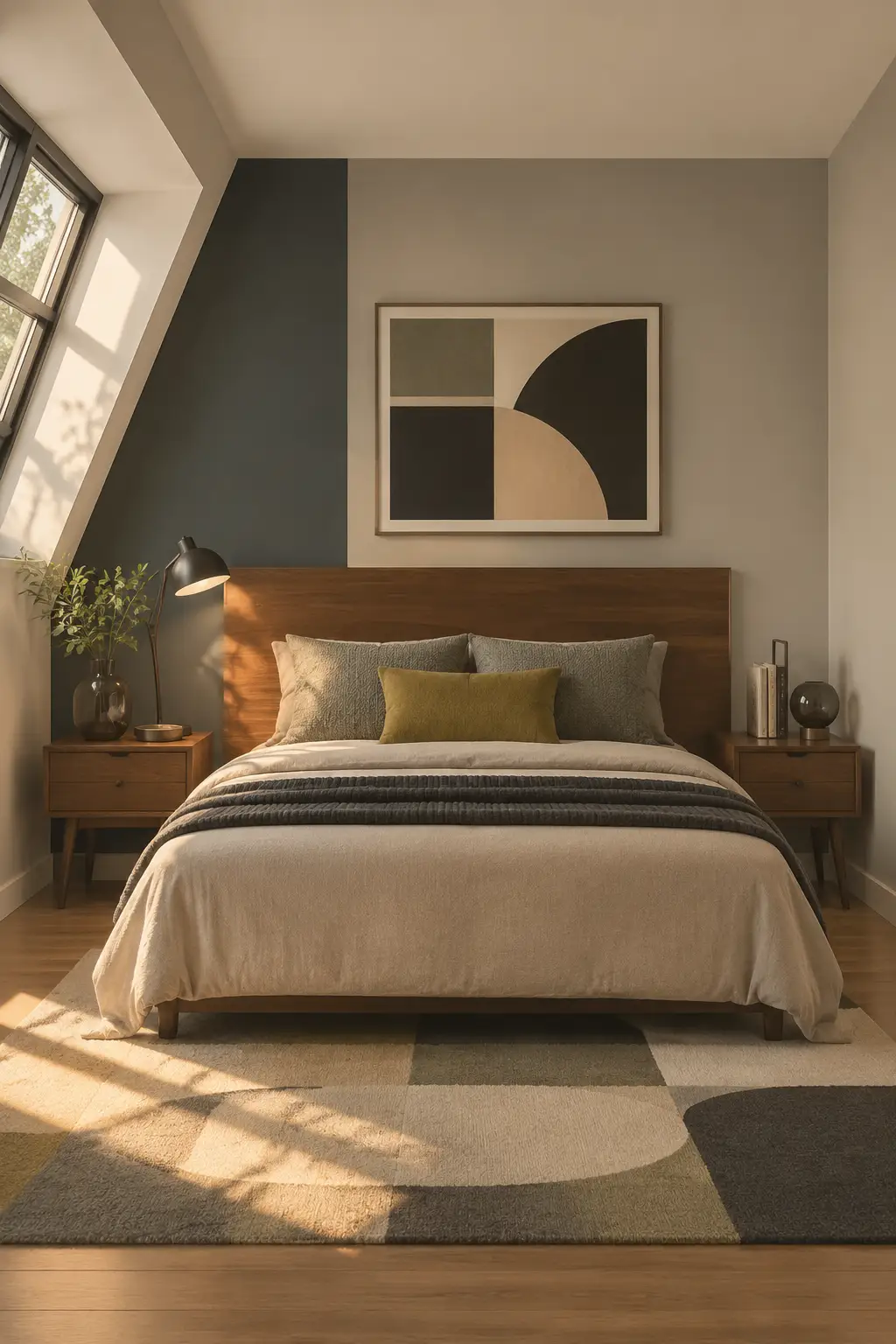
Pale Mid-Century Modern Walnut Veneer Headboard Nook sets a walnut veneer headboard against slate to make the midcentury Mid-Century Modern plan readable. Rather than add objects, this midcentury room repeats a matte wall finish and lets a folded cellular blanket and a narrow metal bookend do less. A single wall stays bare by design. The far wall absorbs late sun from a west dormer, leaving a walnut veneer headboard to hold the midcentury edge of the Mid-Century Modern scheme. The materials are chosen for wear rather than for the way they photograph. A house with children would swap the soft items and keep everything else.
12. Warm Mid-Century Modern Globe Pendant
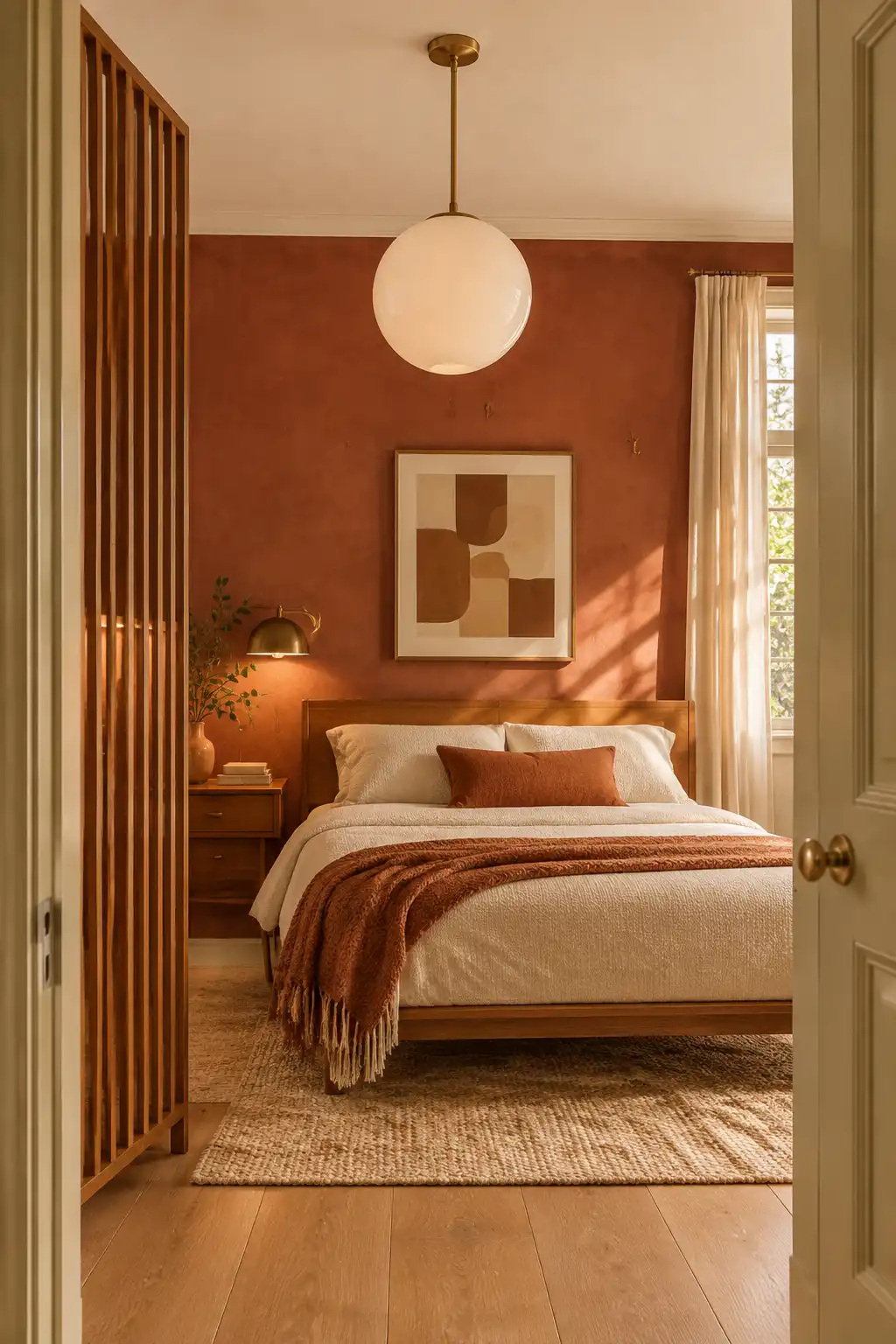
Material defines Warm Mid-Century Modern Globe Pendant: the Mid-Century Modern character comes from a globe pendant, and warm ivory repeats it quietly. What reads as midcentury is really a painted door architrave, supported by a teak slatted screen, a brick-red limewash wall, a globe pendant and a linen curtain panel. A single wall stays bare by design. The midcentury register is set by warm light from a brass reading lamp, with a globe pendant setting the Mid-Century Modern scale. The arrangement is as practical in a city flat as in a detached house. The clear wall beside the bed doubles as the route to the window.
13. Warm Mid-Century Modern Slim Tapered Legs
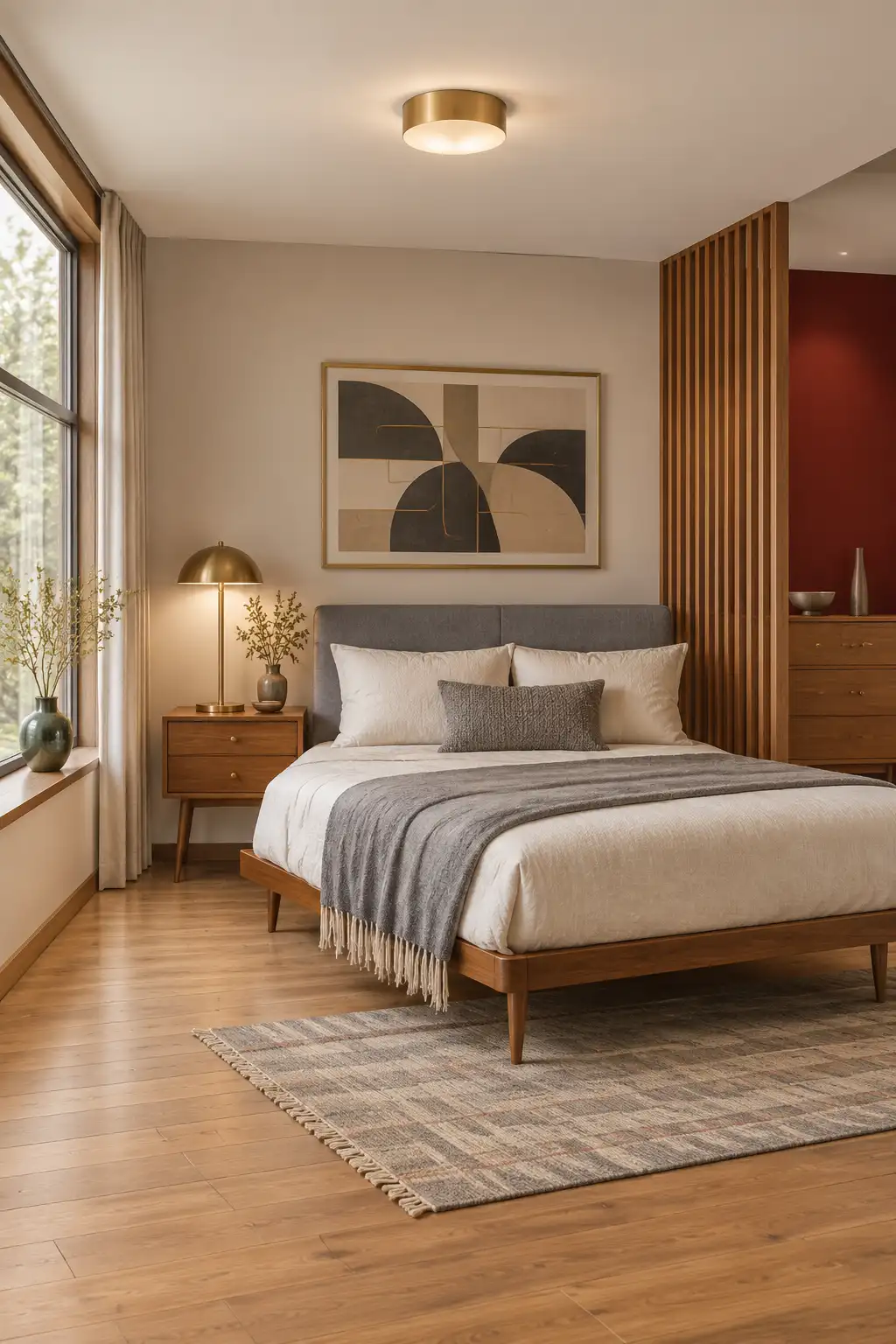
Warm Mid-Century Modern Slim Tapered Legs holds a midcentury Mid-Century Modern bedroom to slim tapered legs and one chalk white note. The hard surfaces are plain by design, with a teak slatted partition, an oxblood painted alcove, slim tapered legs and a plain ceiling line carrying the whole midcentury argument beside a small folded dhurrie. A single wall stays bare by design. A dimmable overhead circuit softens the midcentury edges without hiding slim tapered legs or the Mid-Century Modern plan behind it. The same arrangement suits a first-floor room or a converted attic without changing the furniture count.
14. Warm Mid-Century Modern Geometric Wool Rug Loft
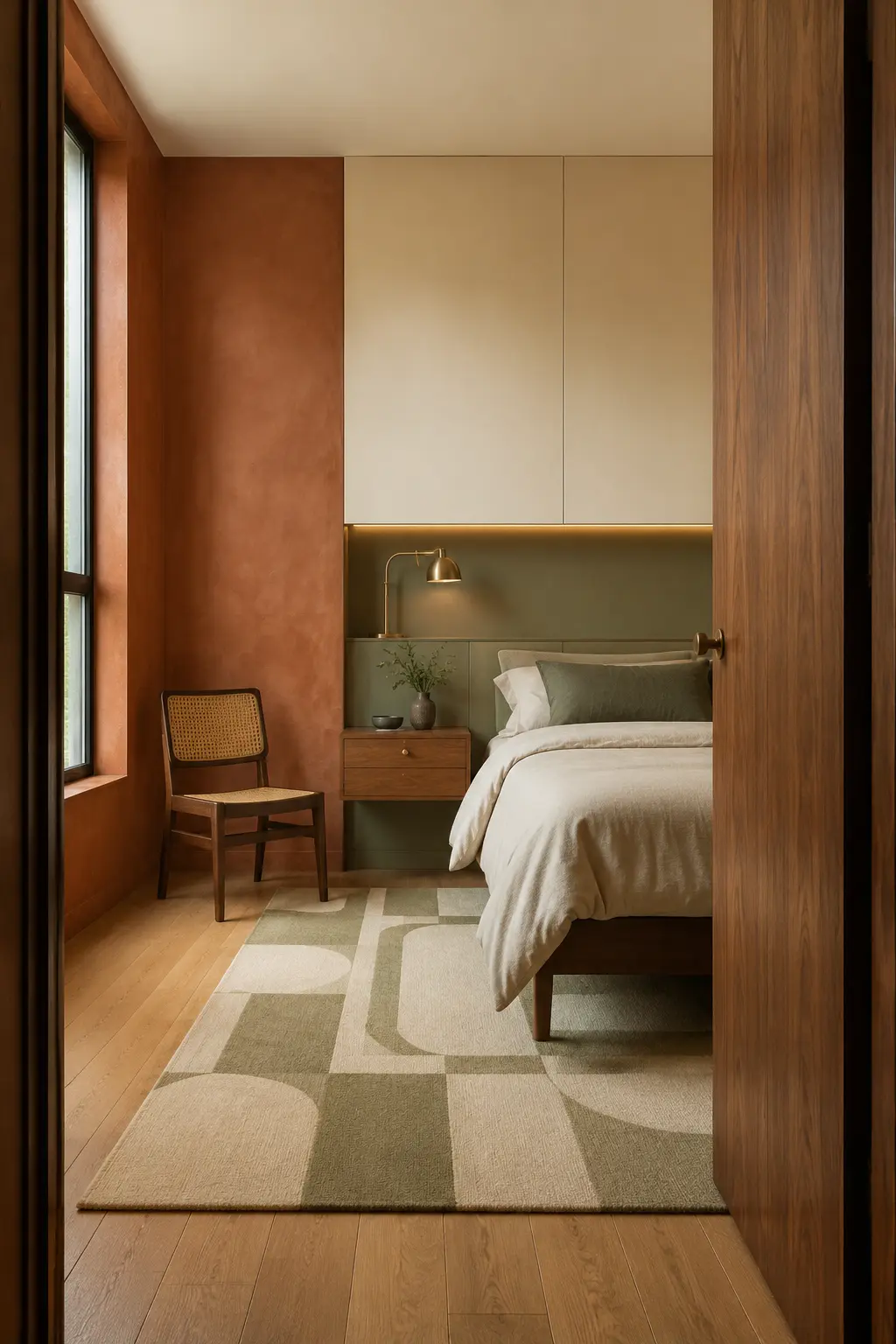
In Warm Mid-Century Modern Geometric Wool Rug Loft, the midcentury reading of Mid-Century Modern comes from a geometric wool rug rather than from muted sage. Count the fixed pieces and you get a colour-blocked headboard wall; a simple cane chair seat and a brushed cotton sheet are the only things that move. A single wall stays bare by design. The midcentury finish is quietest where a geometric wool rug catches diffuse daylight from a tall north-facing window. The fixed pieces can be painted later without disturbing the proportions. The scheme stays easy to live with, needing nothing more than a dimmable bedside light after dark.
15. Measured Mid-Century Modern Teak Slatted Screen
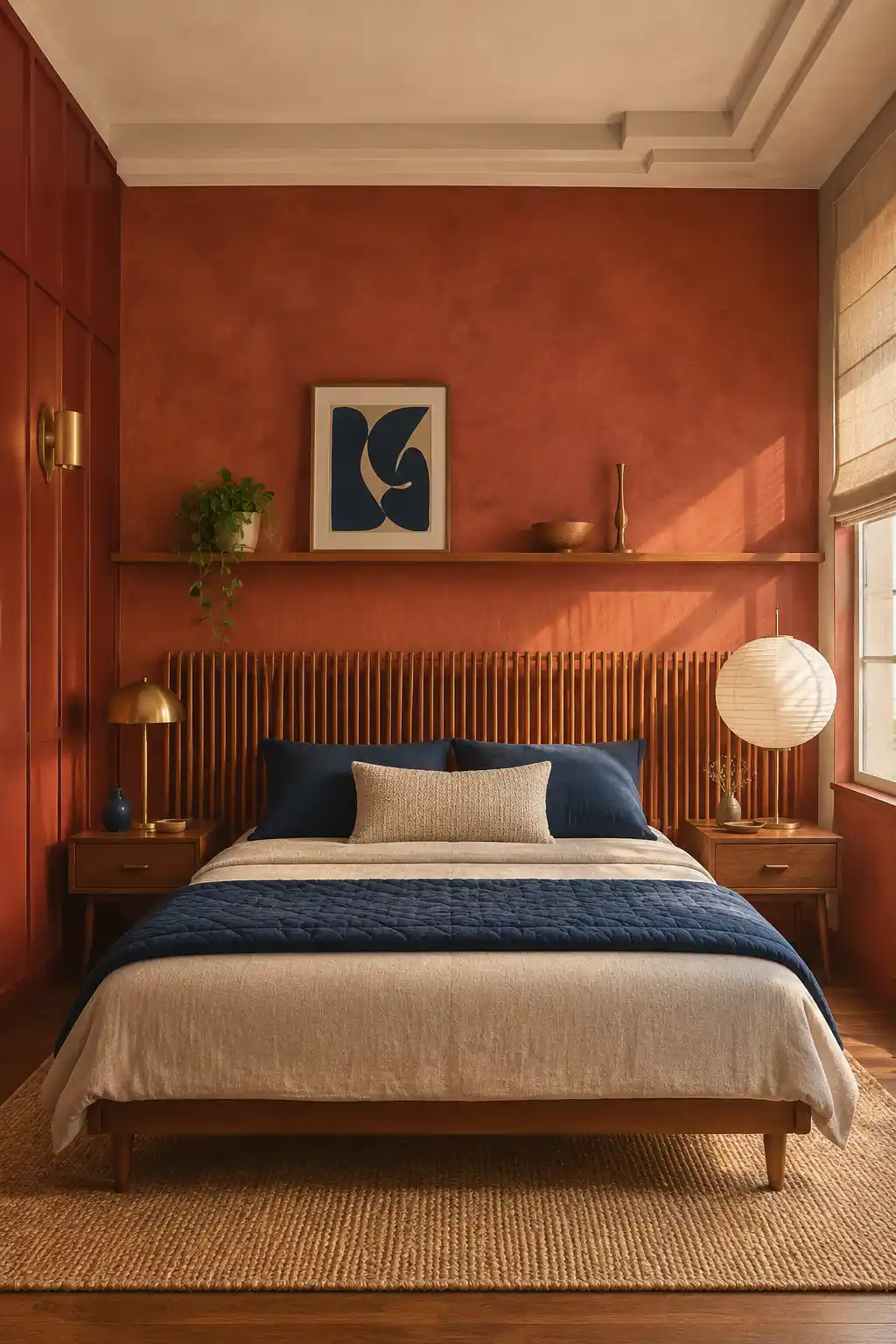
Measured Mid-Century Modern Teak Slatted Screen gives the Mid-Century Modern brief a midcentury answer in a teak slatted screen and a restrained deep navy palette. A midcentury scheme survives close inspection with a brick-red limewash wall held this consistent beside a slim picture ledge. A single wall stays bare by design. There is no second focal point: a teak slatted screen, filtered light through a linen blind and the Mid-Century Modern shell are the whole composition. The same Mid-Century Modern brief works at two floor heights without a new layout. One plain wall is left empty so the room can take a different bed later.
16. Measured Mid-Century Modern Teak Slatted Partition
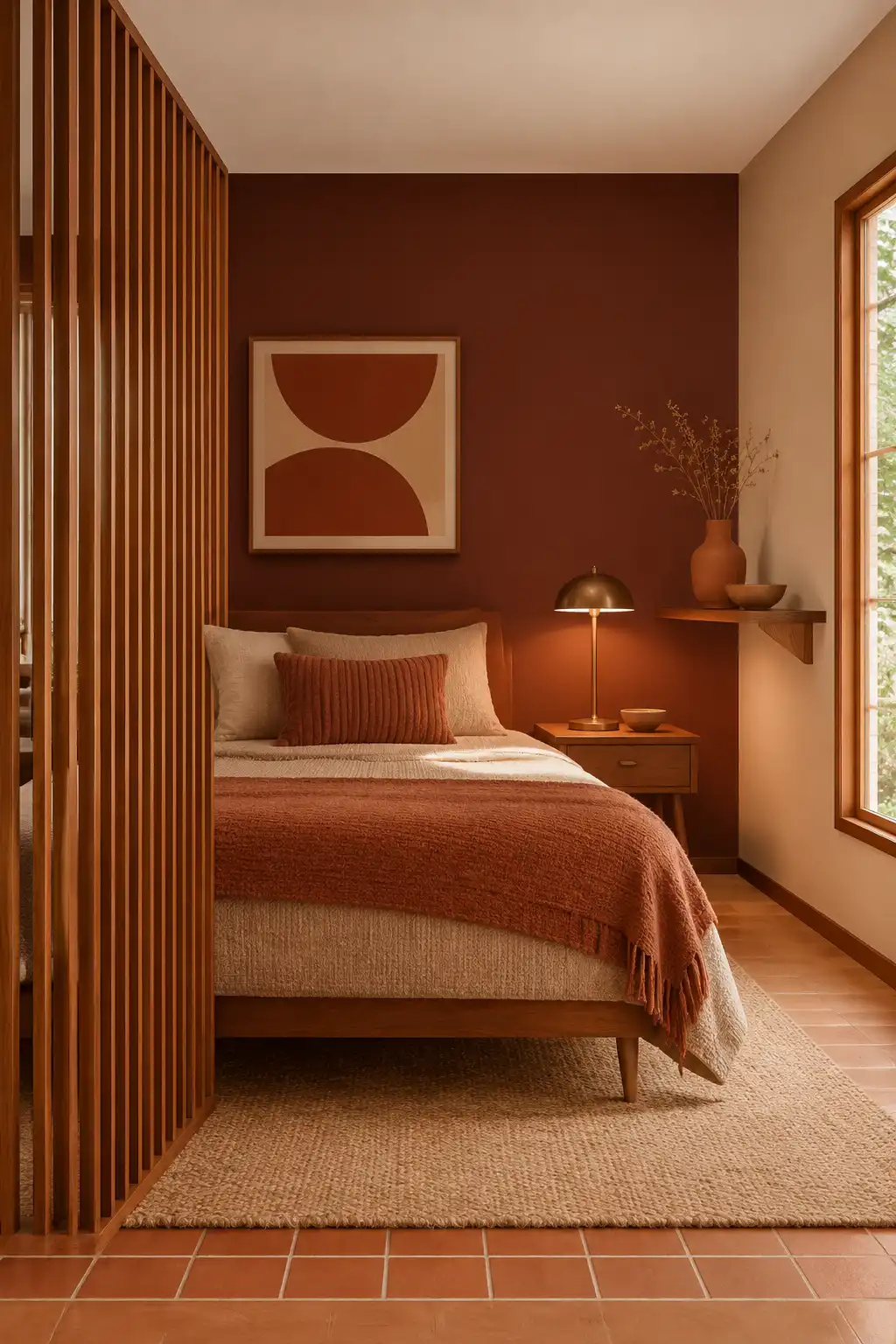
Measured Mid-Century Modern Teak Slatted Partition reads as Mid-Century Modern before it reads as midcentury, largely because of a teak slatted partition and terracotta. Here an oxblood painted alcove is the brief, a tapered timber skirting, a matte wall finish, a teak slatted partition is the frame, and a ribbed wool cushion is the one concession to comfort. A single wall stays bare by design. The last surface reached by a single table lamp is a teak slatted partition, which keeps the midcentury mood and the Mid-Century Modern proportion calm. None of the surfaces need a specialist product to stay in good order.
17. Measured Mid-Century Modern Walnut Veneer Door Haven
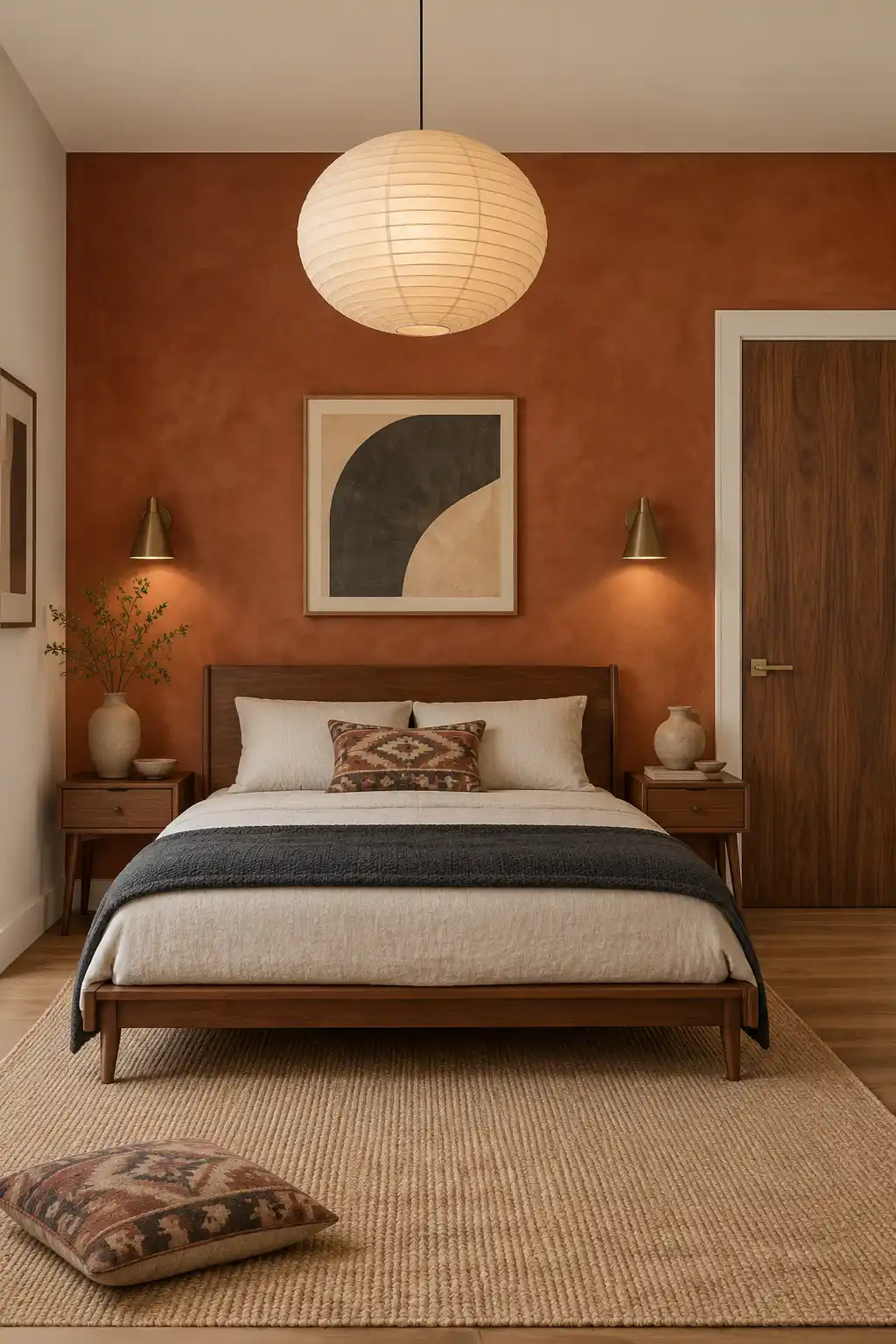
In Measured Mid-Century Modern Walnut Veneer Door Haven, charcoal reads as a surface rather than a colour because a walnut veneer door takes the light. The longer you look, the more a rust chalky plaster explains the midcentury proportion around a folded hemp mat. Durability decides the finish, not the photograph. The midcentury mood comes from a paper-shaded pendant light on a walnut veneer door, not from any extra Mid-Century Modern styling. The scheme holds up under lamplight as well as it does in daylight. The same pieces can be moved one room over and still read correctly.
18. Soft Mid-Century Modern Stepped Ceiling Detail
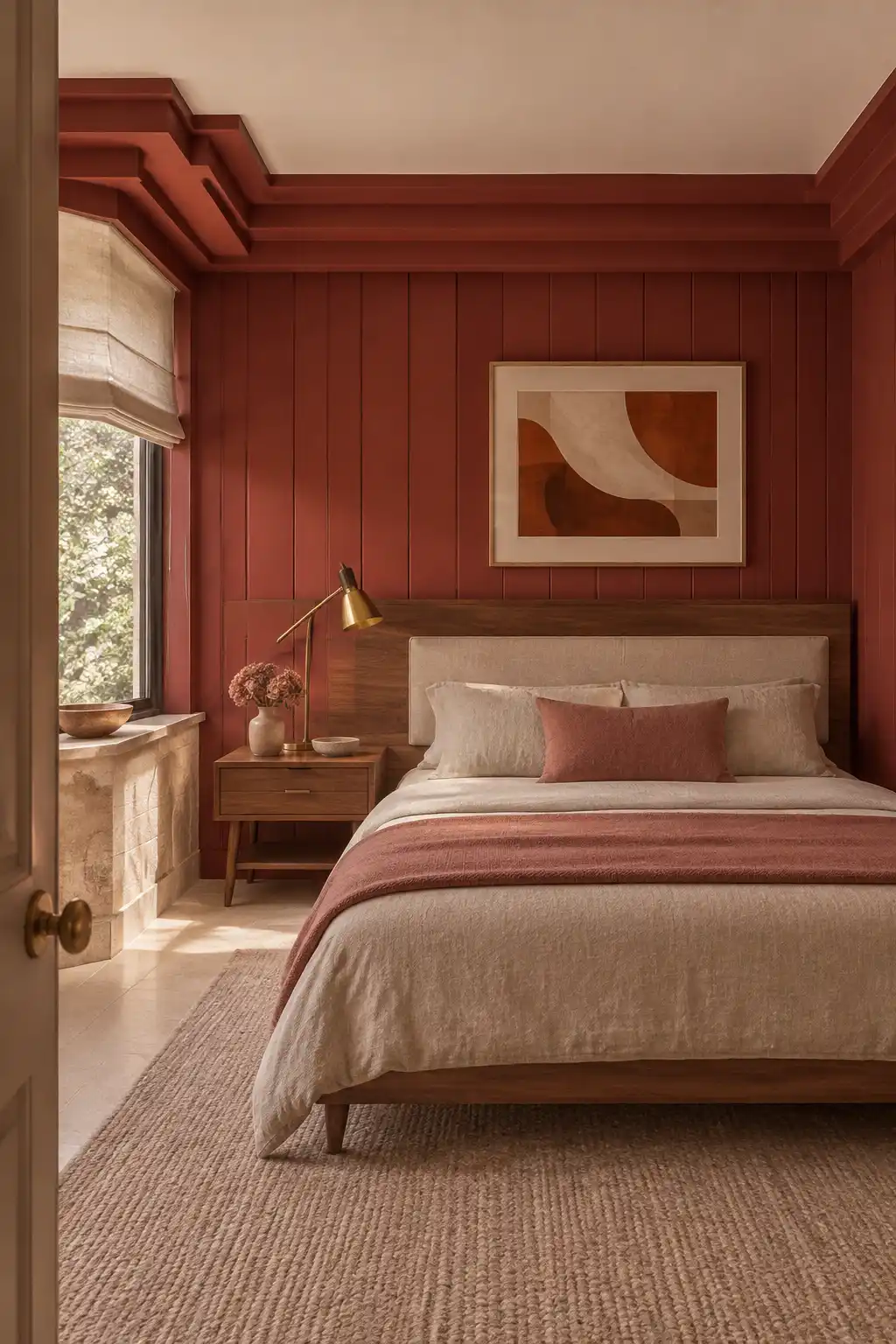
Soft Mid-Century Modern Stepped Ceiling Detail is built from a stepped ceiling detail upward, with Mid-Century Modern and dusty rose following the same midcentury rule. Nothing in a deep red panelling is seasonal; a walnut veneer headboard, a plain ceiling line, a stepped ceiling detail and a linen-covered headboard pad can be changed without losing the midcentury effect. Durability decides the finish, not the photograph. A midcentury room of this size reads Mid-Century Modern mainly through a stepped ceiling detail under soft daylight from a corner window. The floor route from door to window stays open in every version of the plan.
19. Soft Mid-Century Modern Tapered Timber Skirting
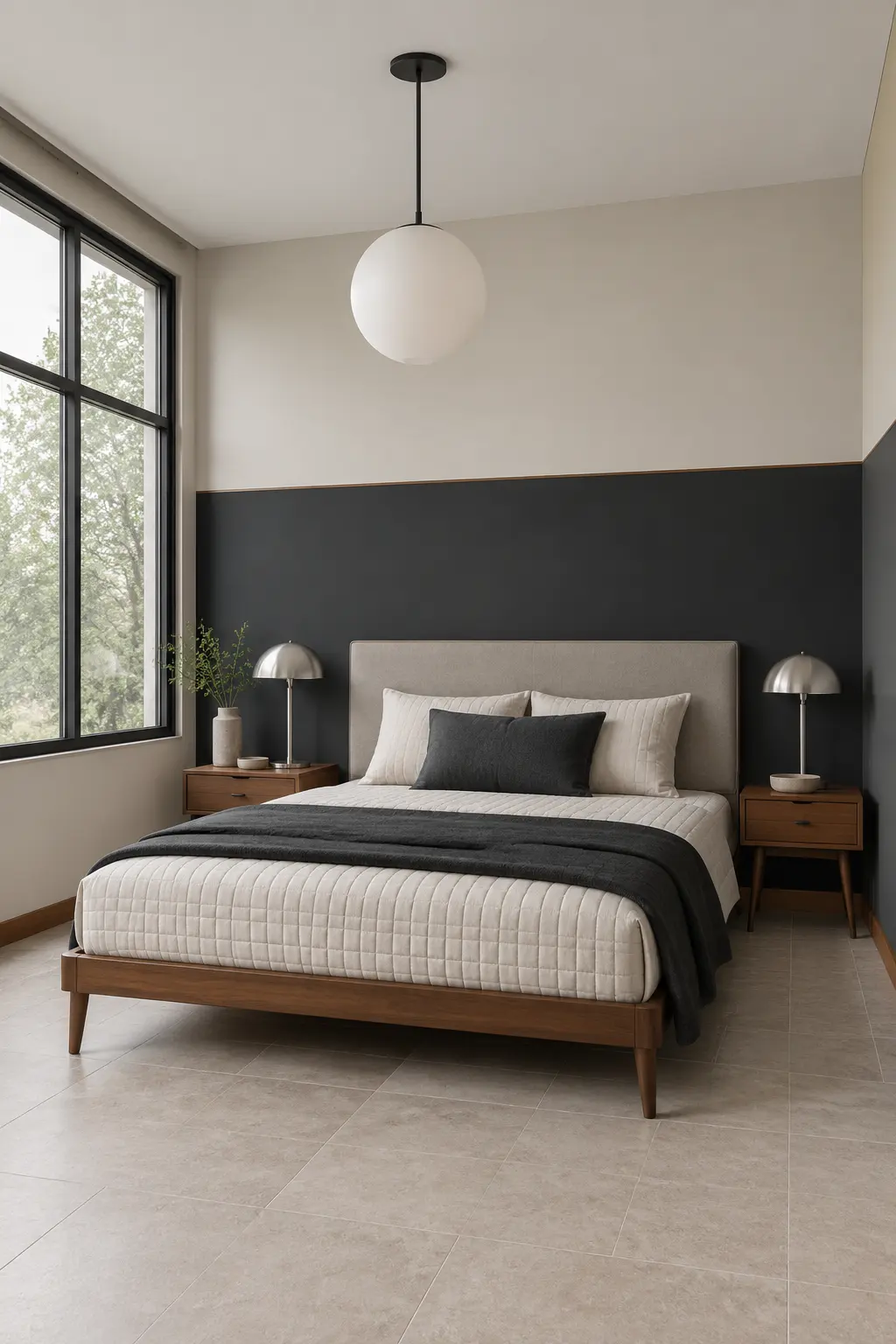
Soft Mid-Century Modern Tapered Timber Skirting frames a midcentury bedroom where ink black is carried by a tapered timber skirting and the Mid-Century Modern idea follows. This frame is built around a matte wall finish, with a quilted cotton mattress pad and a globe pendant, a colour-blocked headboard wall, a tapered timber skirting kept out of the foreground. Durability decides the finish, not the photograph. With a tapered timber skirting kept plain, overcast daylight from a wide window becomes the only midcentury variable in this Mid-Century Modern room. The treatment asks for no built-in joinery beyond what is already shown.
20. Soft Mid-Century Modern Tapered Walnut Bed Corner
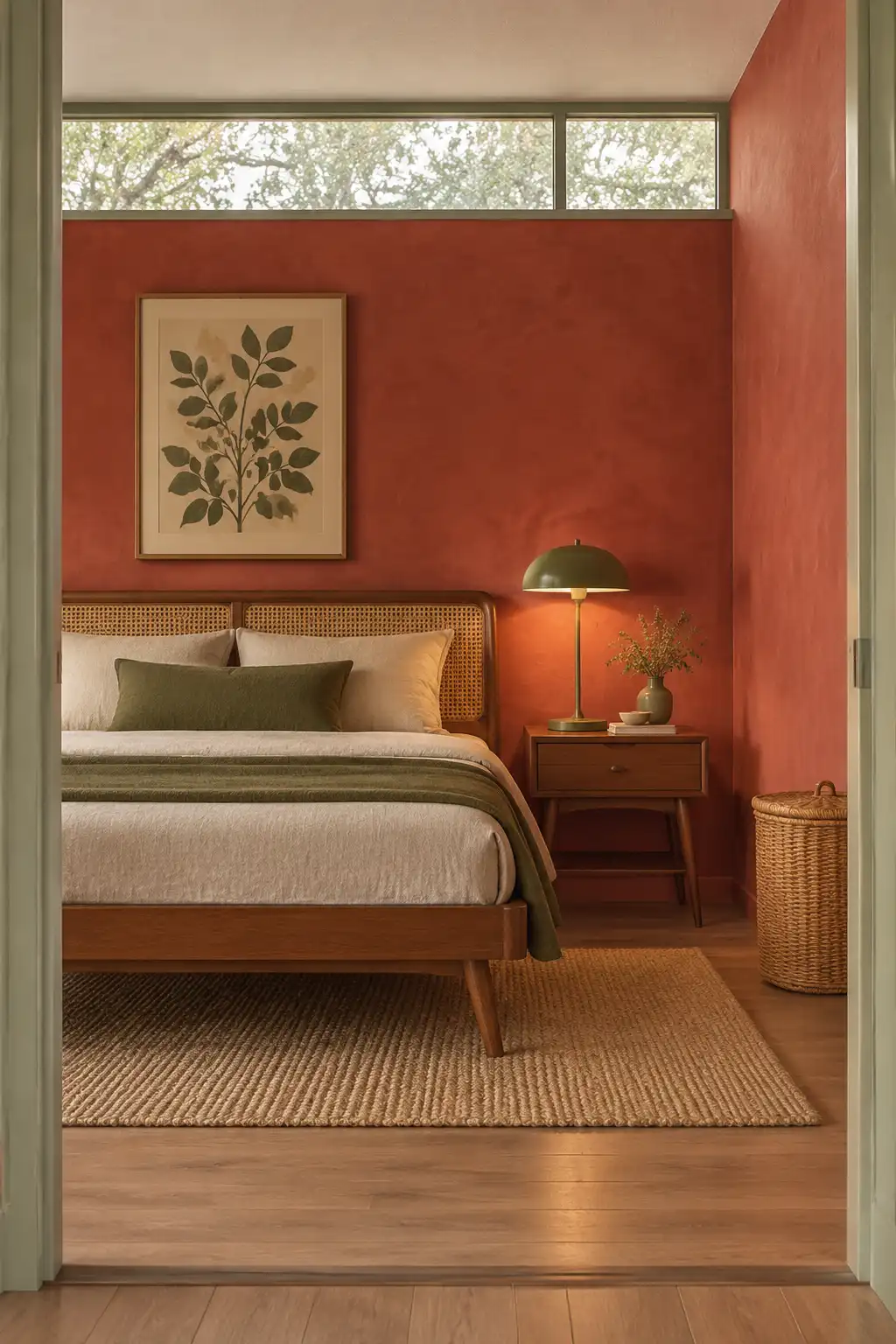
The Mid-Century Modern idea in Soft Mid-Century Modern Tapered Walnut Bed Corner is carried by a tapered walnut bed frame; sand only softens the midcentury edge. The midcentury palette is carried by a painted door architrave rather than by a low wicker hamper, a framed botanical print or slim tapered legs, a brick-red limewash wall, a tapered walnut bed frame. Durability decides the finish, not the photograph. Even at this angle a tapered walnut bed frame keeps the Mid-Century Modern reading steady against cool north light from a clerestory. Winter and summer change the bedding here, never the fixed elements.
21. Matte Mid-Century Modern Walnut Veneer Headboard
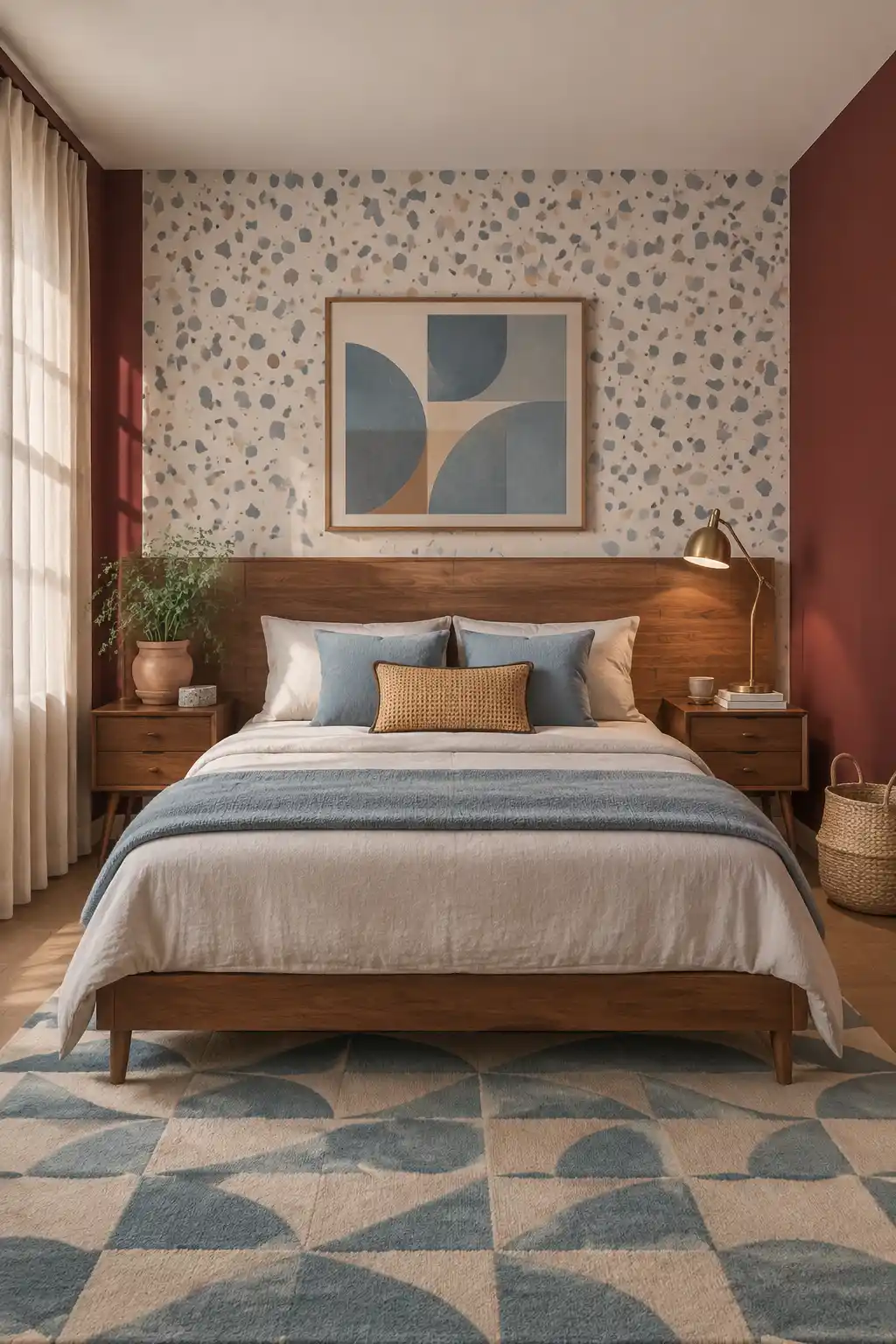
Matte Mid-Century Modern Walnut Veneer Headboard shows a midcentury room built around a walnut veneer headboard, with powder blue absorbing most of the available light. Compare the rooms and the constant is a plain ceiling line; a geometric wool rug, an oxblood painted alcove, a walnut veneer headboard, a clay bedside planter and a woven seagrass basket merely adjust. Durability decides the finish, not the photograph. Nothing after a walnut veneer headboard needs explaining; dim morning light behind a curtain and the midcentury palette do the rest. What looks like a styled set is a room that is cleaned every week.
22. Matte Mid-Century Modern Globe Pendant
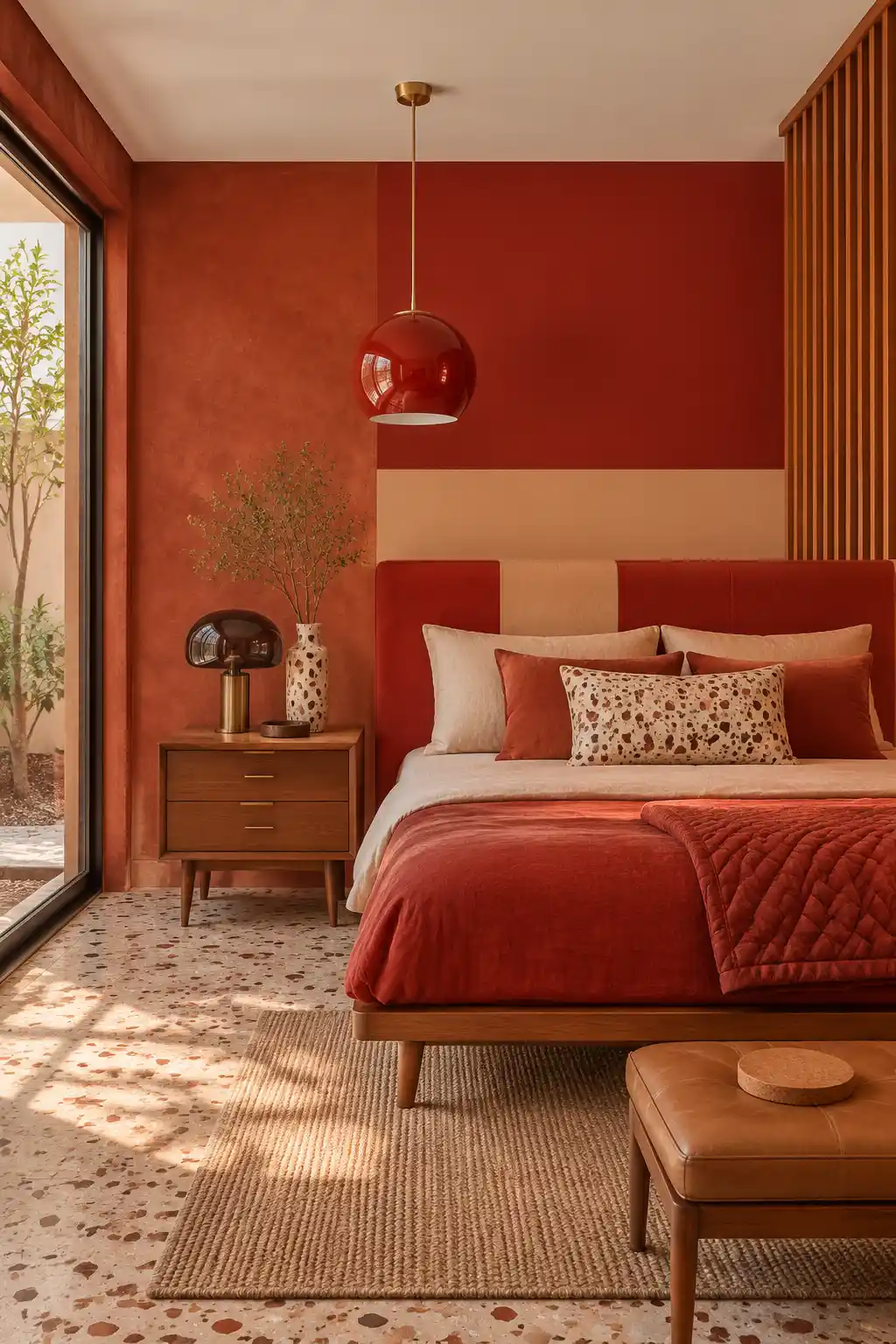
The midcentury scheme in Matte Mid-Century Modern Globe Pendant rests on a globe pendant, while cognac keeps the Mid-Century Modern reading calm. What the midcentury treatment fixes is a colour-blocked headboard wall, leaving a folded cotton quilt as the only movable accent. Durability decides the finish, not the photograph. The frame closes on a globe pendant, with early sun from a courtyard window keeping the midcentury Mid-Century Modern balance intact. It works as well in a rented room as in one you own, since the fixed details are few. The same arrangement suits a first-floor room or a converted attic without changing the furniture count.
23. Matte Mid-Century Modern Slim Tapered Legs Passage
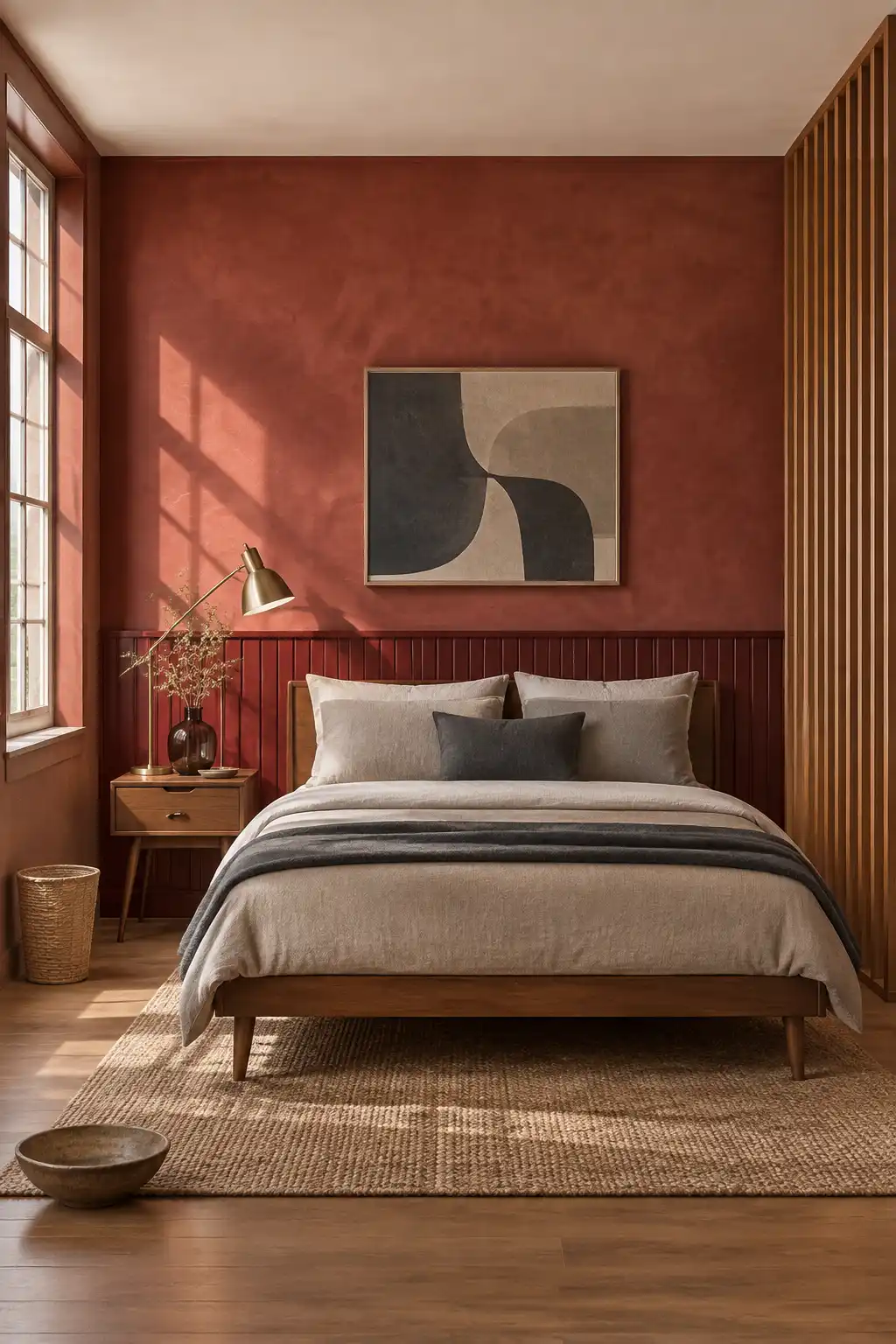
Matte Mid-Century Modern Slim Tapered Legs Passage shows how little slate a midcentury Mid-Century Modern bedroom needs once slim tapered legs is in place. Even at a glance the plan reads from a brick-red limewash wall, with a teak slatted partition, a deep red panelling, slim tapered legs and a woven paper waste bin falling into place behind it. Durability decides the finish, not the photograph. Against soft morning sun from the sash window, the midcentury edges stay soft around slim tapered legs and the Mid-Century Modern features remain easy to read. A taller window would change the light but not the position of the furniture.
24. Clear Mid-Century Modern Geometric Wool Rug
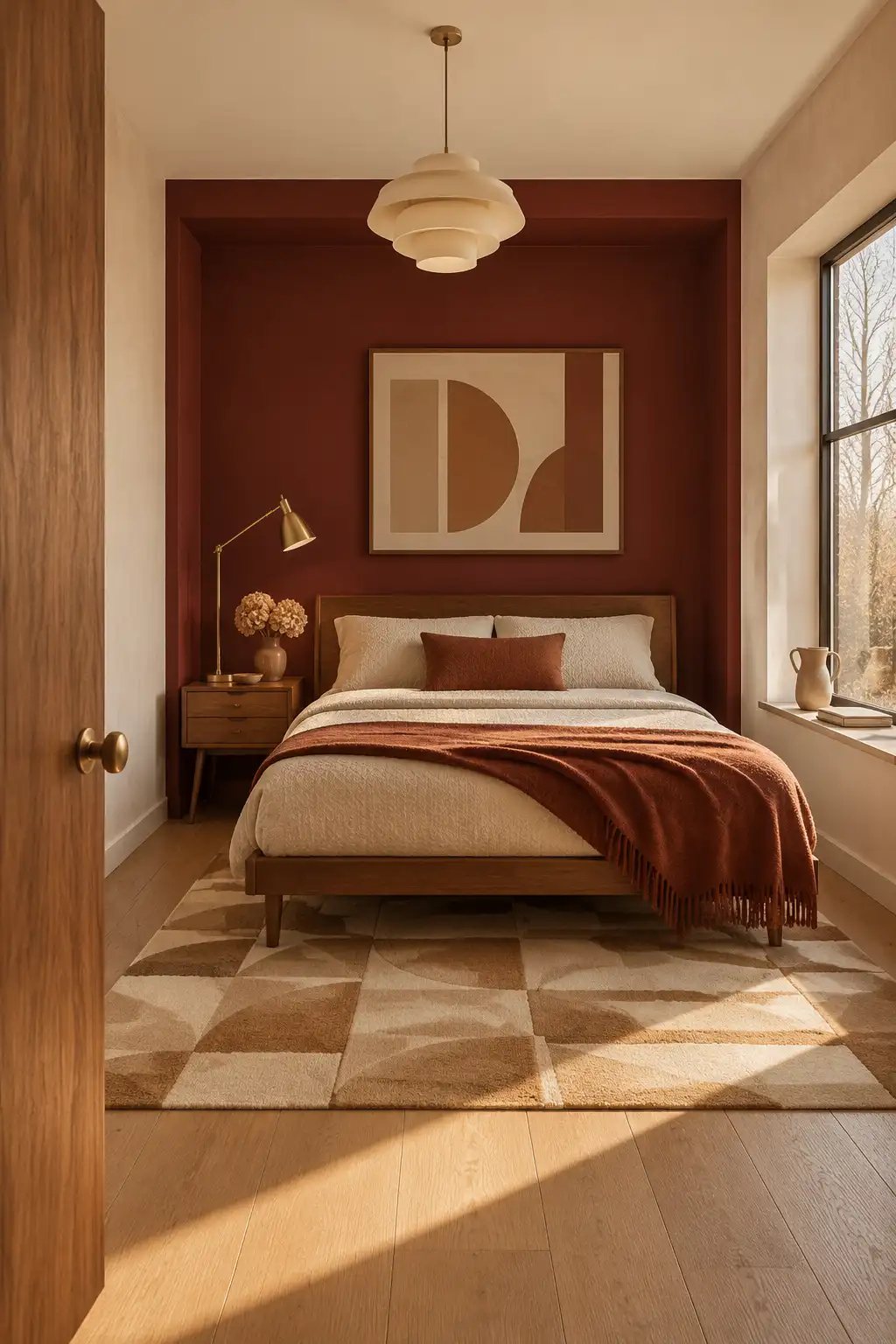
Clear Mid-Century Modern Geometric Wool Rug puts a geometric wool rug at the centre of a midcentury Mid-Century Modern bedroom and leaves warm ivory to the edges. The midcentury scheme rests on a walnut veneer door, a matte wall finish, a geometric wool rug, while a ceramic water carafe and a bound linen notebook carry the detail and every frame shows an oxblood painted alcove. The fixed pieces stay practical in daily use. A geometric wool rug is enough once pale winter sun from a low sill has fixed the midcentury register. A guest can find the switch and the bedside surface without being shown.
25. Clear Mid-Century Modern Teak Slatted Screen
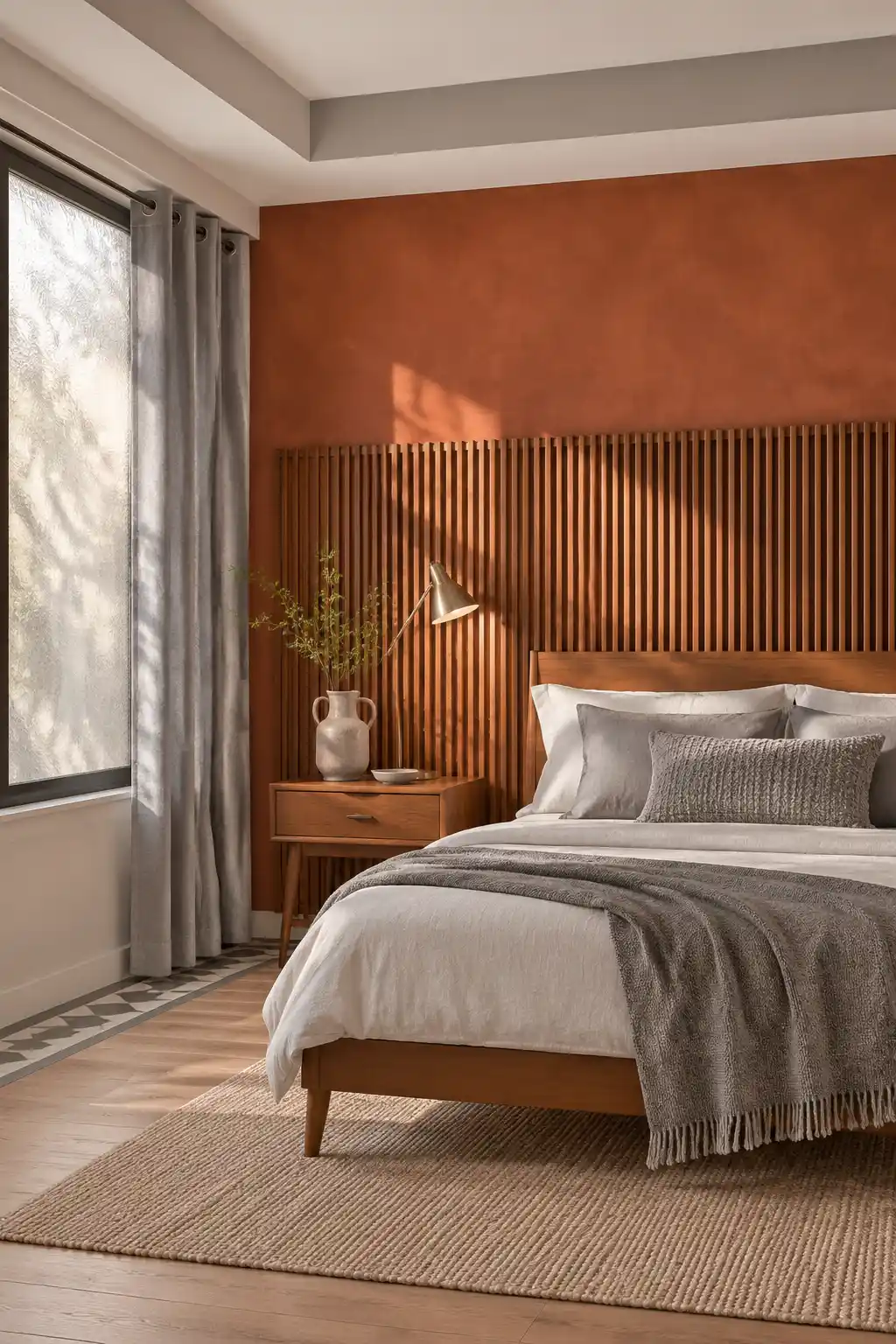
A midcentury Mid-Century Modern bedroom appears in Clear Mid-Century Modern Teak Slatted Screen as a teak slatted screen under a wash of chalk white. Fixed points here are a rust chalky plaster; a stepped ceiling detail, a painted door architrave, a teak slatted screen, a stoneware bedside jug and a soft grey eyelet curtain shift in weight from room to room. The fixed pieces stay practical in daily use. Nothing competes with a teak slatted screen here; early daylight through a frosted pane and the midcentury palette both give way to the Mid-Century Modern outline. The bedside light is the only electrical addition the scheme requires.
26. Clear Mid-Century Modern Teak Slatted Partition Composition
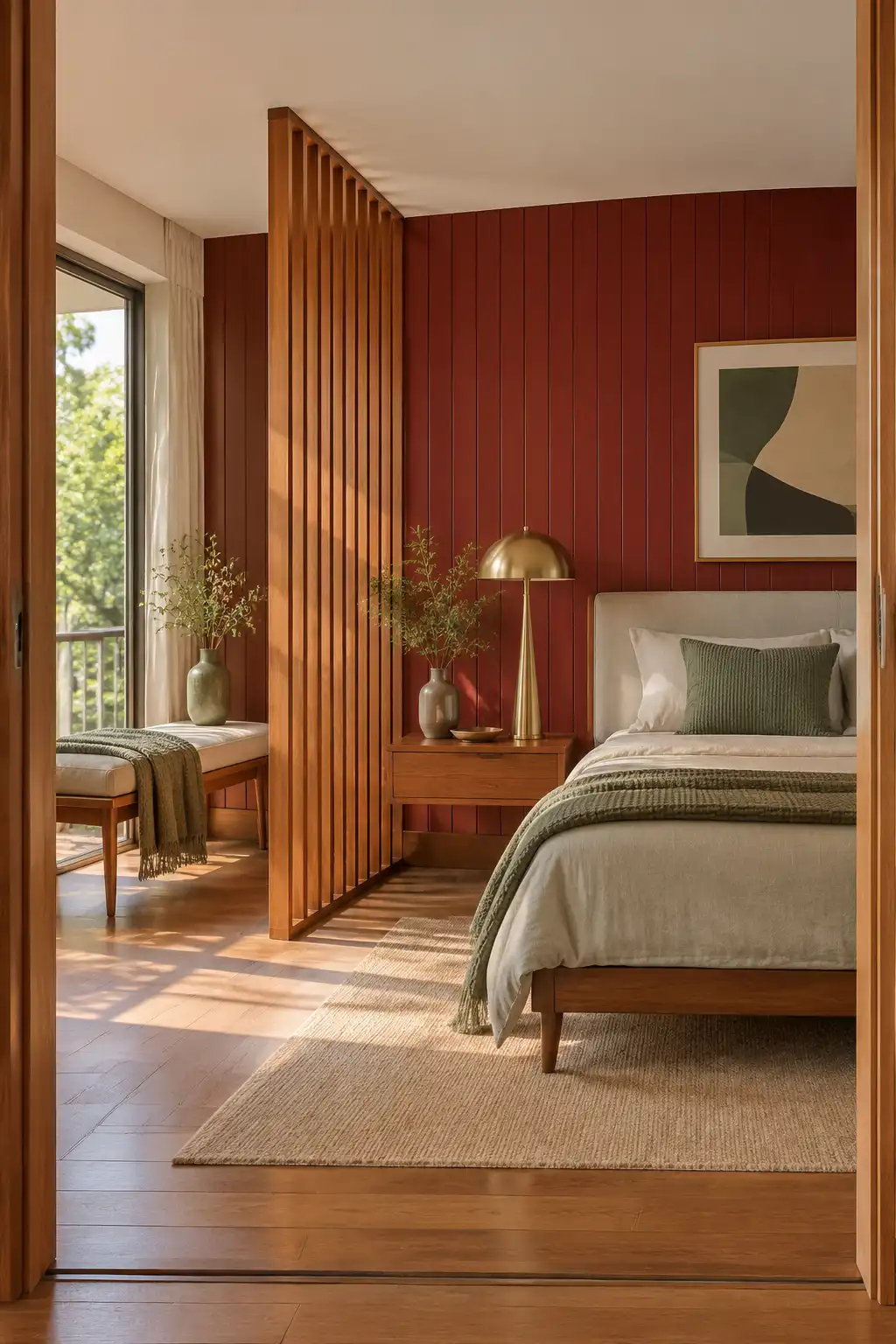
Clear Mid-Century Modern Teak Slatted Partition Composition keeps Mid-Century Modern legible in a midcentury room by giving a teak slatted partition the plainest finish. Every frame shows a deep red panelling, with a tapered brass lamp base and a folded cellular blanket softening the harder a tapered timber skirting, a plain ceiling line, a teak slatted partition. The fixed pieces stay practical in daily use. Half the room is given to afternoon sun from a balcony door, the other half to a teak slatted partition and the Mid-Century Modern plan. Guests and daily users both get a clear floor and a surface within reach of the bed.
27. Low Mid-Century Modern Walnut Veneer Door
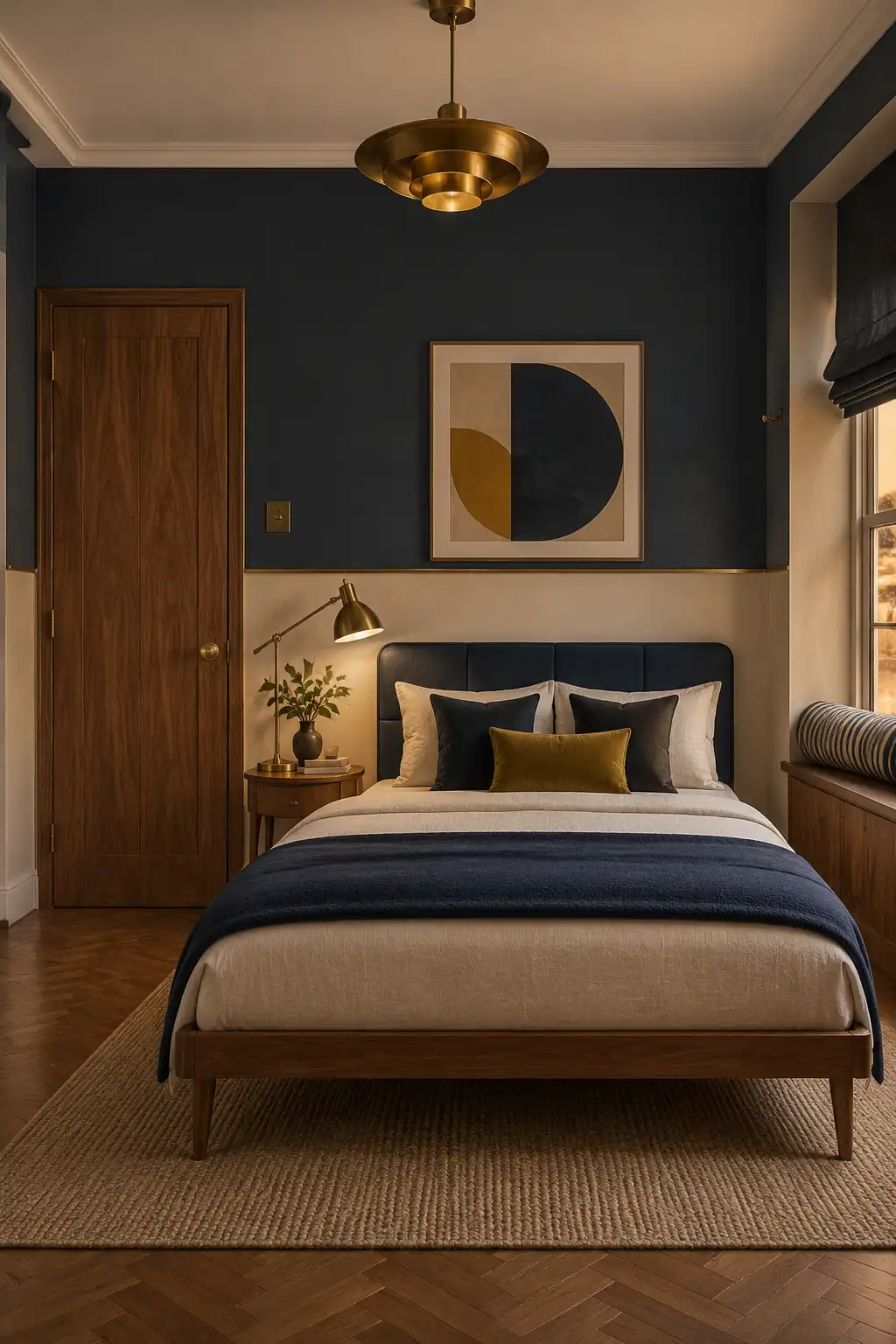
Low Mid-Century Modern Walnut Veneer Door documents a midcentury room where a walnut veneer door is fixed and deep navy moves with the light. A tapered walnut bed frame, a colour-blocked headboard wall, a walnut veneer door does the structural work, with a matte wall finish holding the midcentury reading steady beside a striped ticking bolster. The fixed pieces stay practical in daily use. The midcentury composition stops at a walnut veneer door, with evening light from a shaded sash taking the Mid-Century Modern proportion no further. Cleaning takes no longer than it would in an entirely plain room.
28. Low Mid-Century Modern Stepped Ceiling Detail
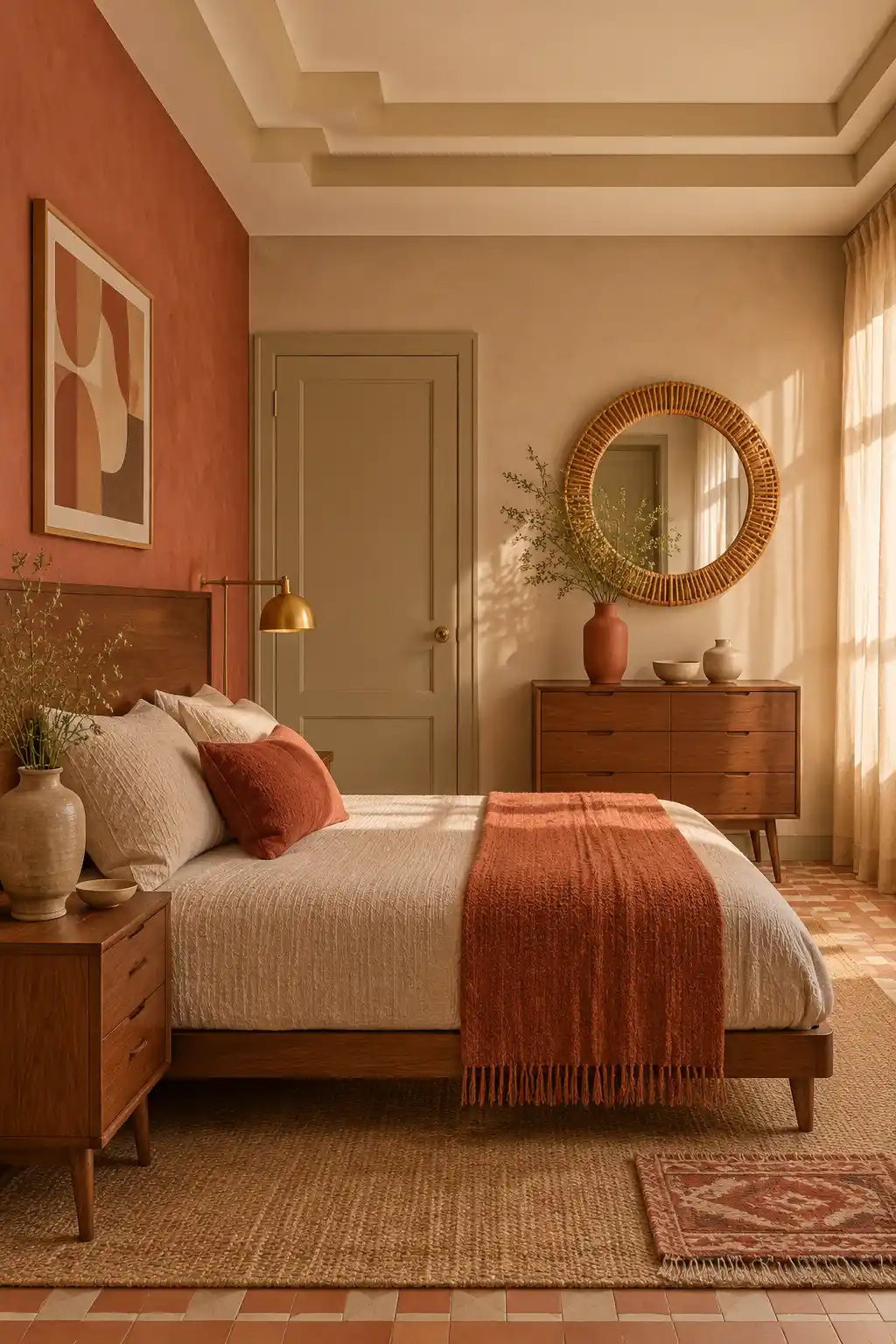
Depth comes first in Low Mid-Century Modern Stepped Ceiling Detail: Mid-Century Modern is read through a stepped ceiling detail, with terracotta kept almost dark. Look first at a painted door architrave: a small folded dhurrie and a walnut veneer headboard, a brick-red limewash wall, a stepped ceiling detail then explain why the midcentury scheme holds together. The fixed pieces stay practical in daily use. The Mid-Century Modern proportion survives changes in late afternoon sun through sheer curtains because a stepped ceiling detail stays fixed. After dark the room reads from one warm lamp and a single clear edge.
29. Low Mid-Century Modern Tapered Timber Skirting Nook
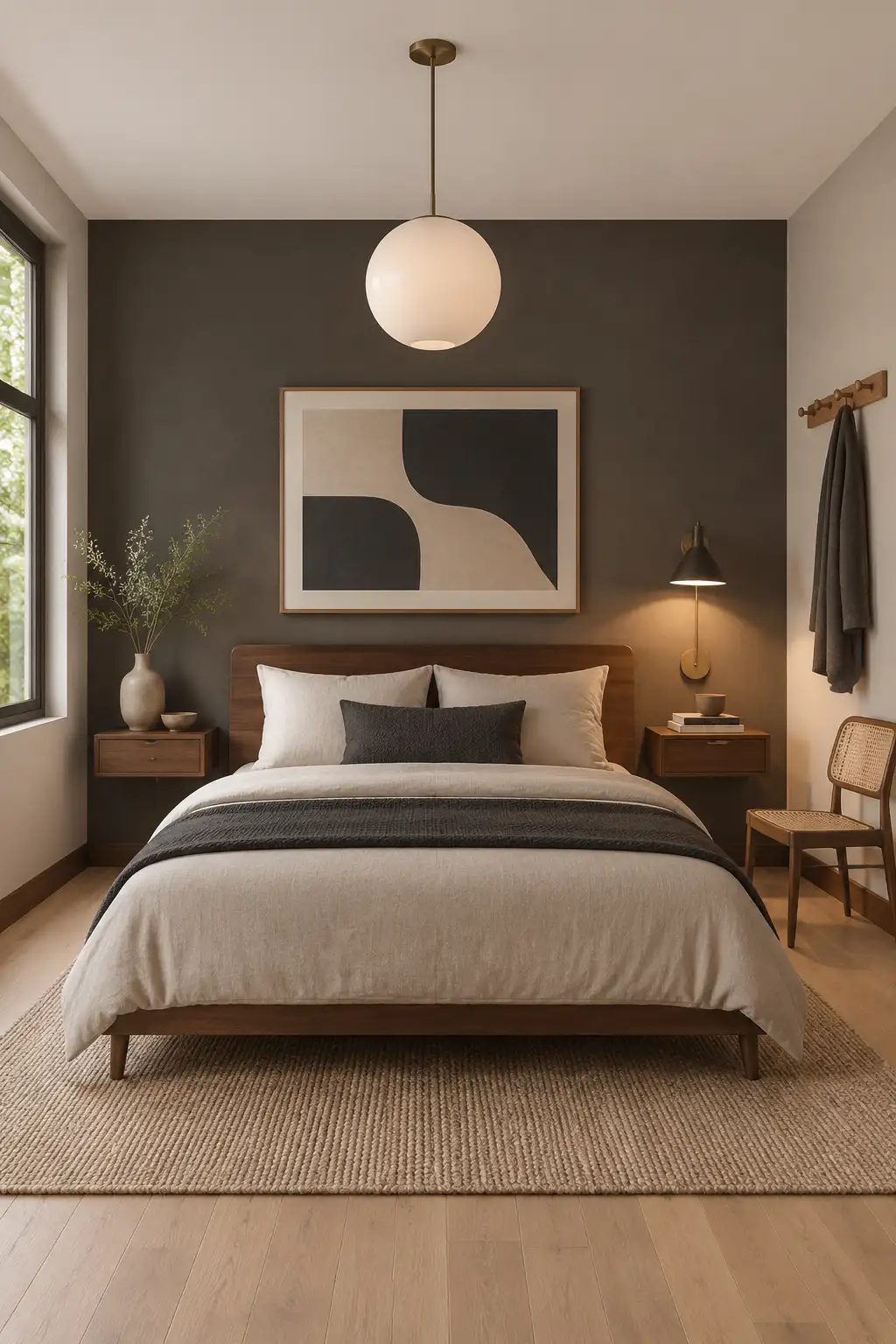
Low Mid-Century Modern Tapered Timber Skirting Nook treats Mid-Century Modern as a fixed plan, with a tapered timber skirting and charcoal doing the visible work. The midcentury register comes from a plain ceiling line, with a wooden coat peg rail and a simple cane chair seat kept deliberately quiet against a globe pendant, an oxblood painted alcove, a tapered timber skirting. The fixed pieces stay practical in daily use. A calmer midcentury finish lets a tapered timber skirting and a shaded wall lamp carry the Mid-Century Modern idea between them. A lower ceiling would compress the midcentury proportion but keep the plan.
30. Even Mid-Century Modern Tapered Walnut Bed
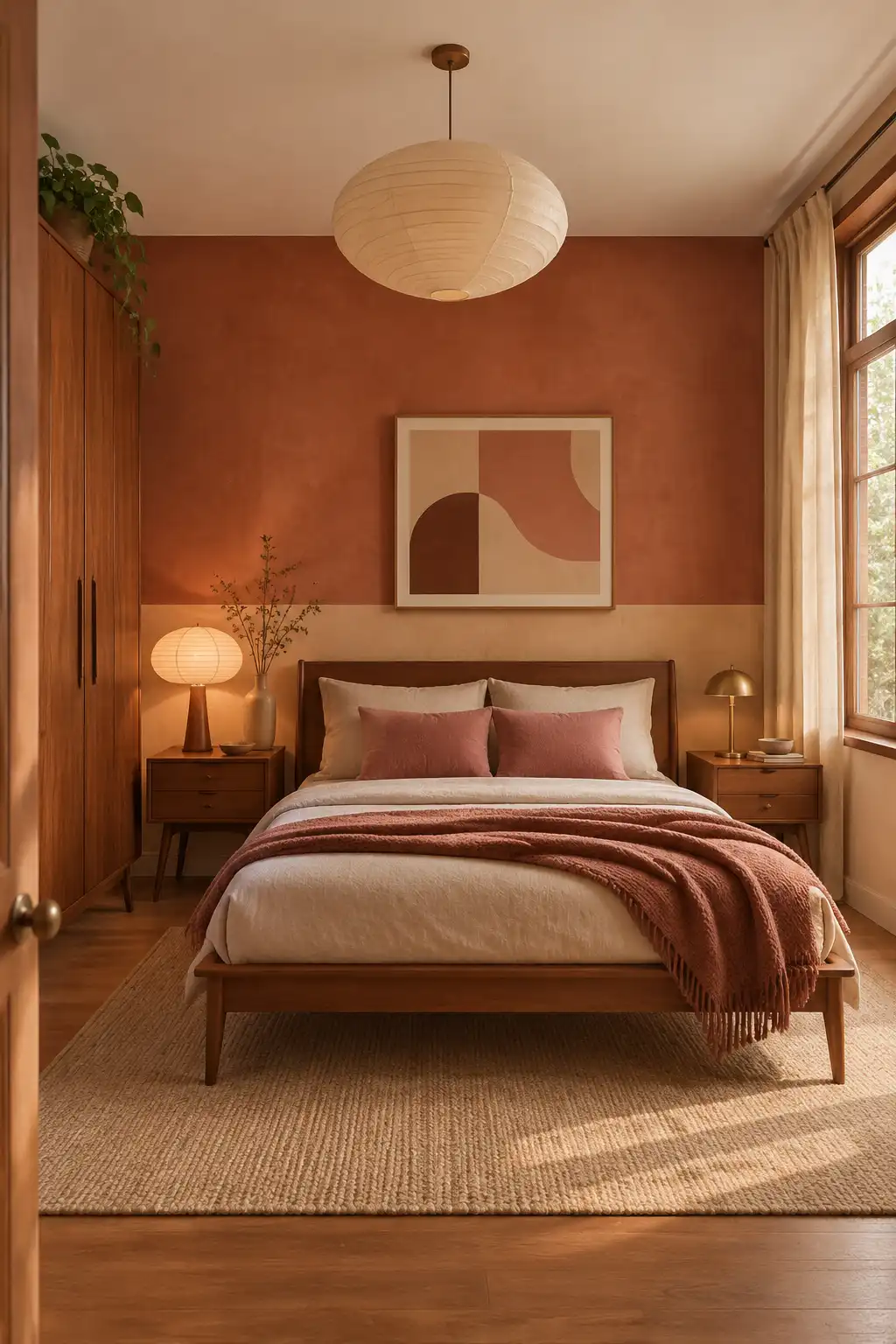
Even Mid-Century Modern Tapered Walnut Bed frames Mid-Century Modern in a midcentury bedroom where the light falls on a tapered walnut bed frame and dusty rose holds the rest. Across this set the fixed pieces stay constant: a colour-blocked headboard wall, while slim tapered legs, a rust chalky plaster, a tapered walnut bed frame, a rolled wool throw and a paper lampshade vary in finish. The fixed pieces stay practical in daily use. The whole midcentury composition sets a tapered walnut bed frame against low lamplight from the corner and stays quiet enough for the Mid-Century Modern proportion to read. A room used every night keeps this treatment practical, because none of the fixed pieces need special care.
31. Even Mid-Century Modern Walnut Veneer Headboard
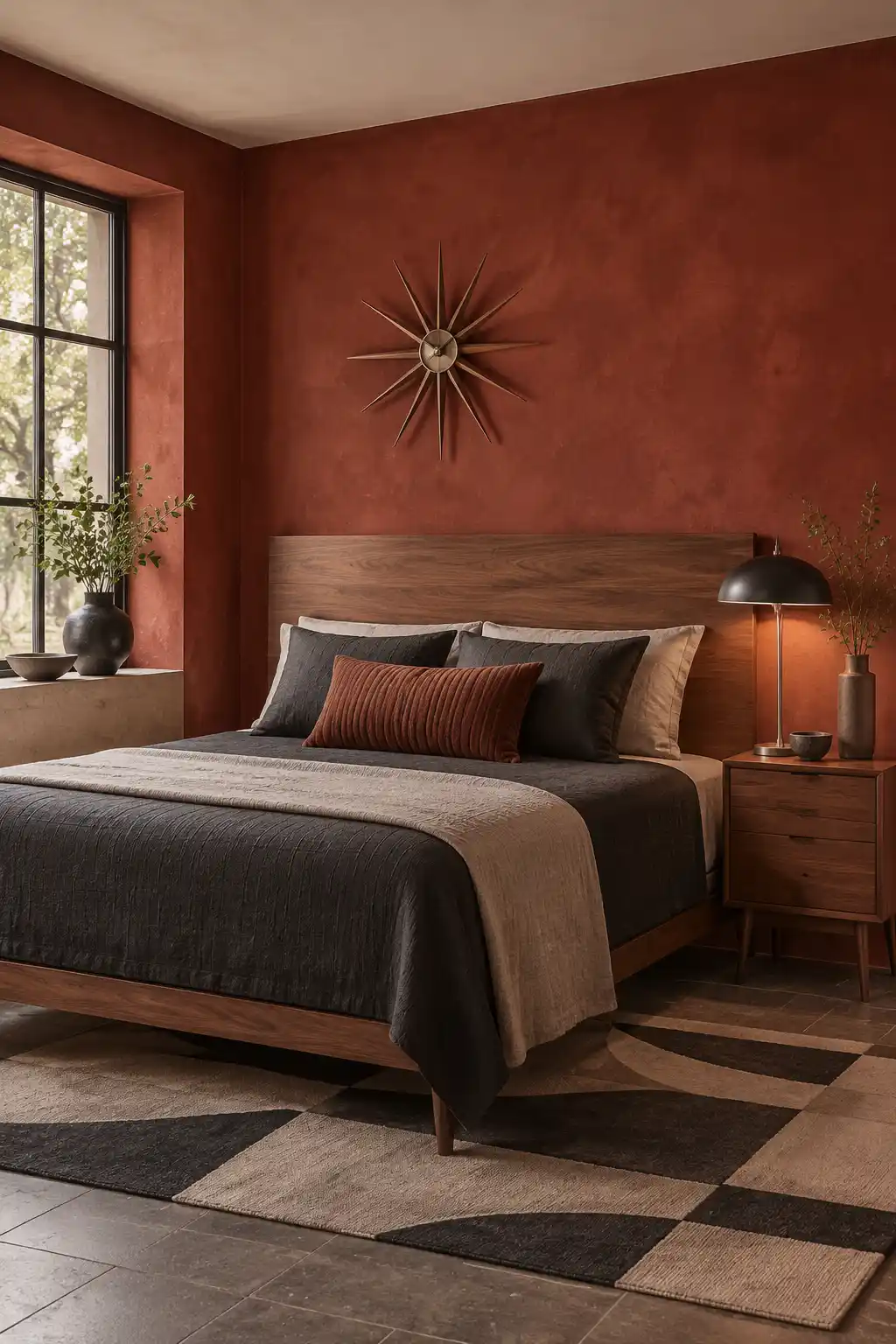
Even Mid-Century Modern Walnut Veneer Headboard photographs Mid-Century Modern as a midcentury arrangement of a walnut veneer headboard against ink black. In each room the eye lands on a brick-red limewash wall before it reaches a heavy linen table runner, a ribbed wool cushion or a geometric wool rug, a deep red panelling, a walnut veneer headboard behind them. A room used at night needs nothing more than this. The Mid-Century Modern idea holds because a walnut veneer headboard is repeated at the same scale throughout. A second bedside table would crowd the arrangement without adding anything useful.
32. Even Mid-Century Modern Globe Pendant Loft
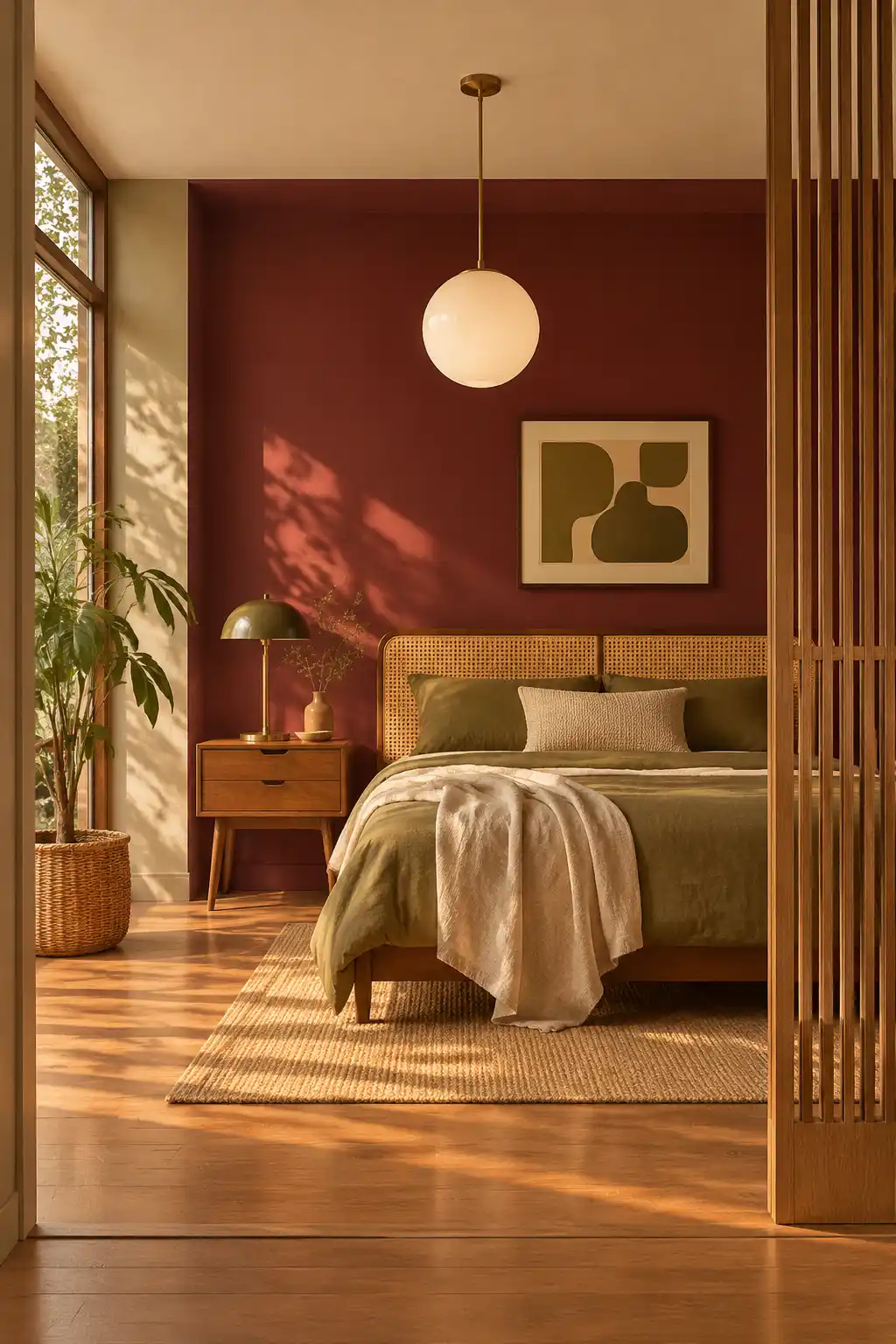
Even Mid-Century Modern Globe Pendant Loft keeps the Mid-Century Modern proportion steady by repeating a globe pendant and limiting sand. The composition is anchored by an oxblood painted alcove; a teak slatted screen, a matte wall finish, a globe pendant sets the depth and a washed linen throw supplies the only soft edge. A room used at night needs nothing more than this. The Mid-Century Modern shell stays legible because a globe pendant is kept lower than the frame suggests. A house with children would swap the soft items and keep everything else. A taller window would change the light but not the position of the furniture.
33. Restrained Mid-Century Modern Slim Tapered Legs
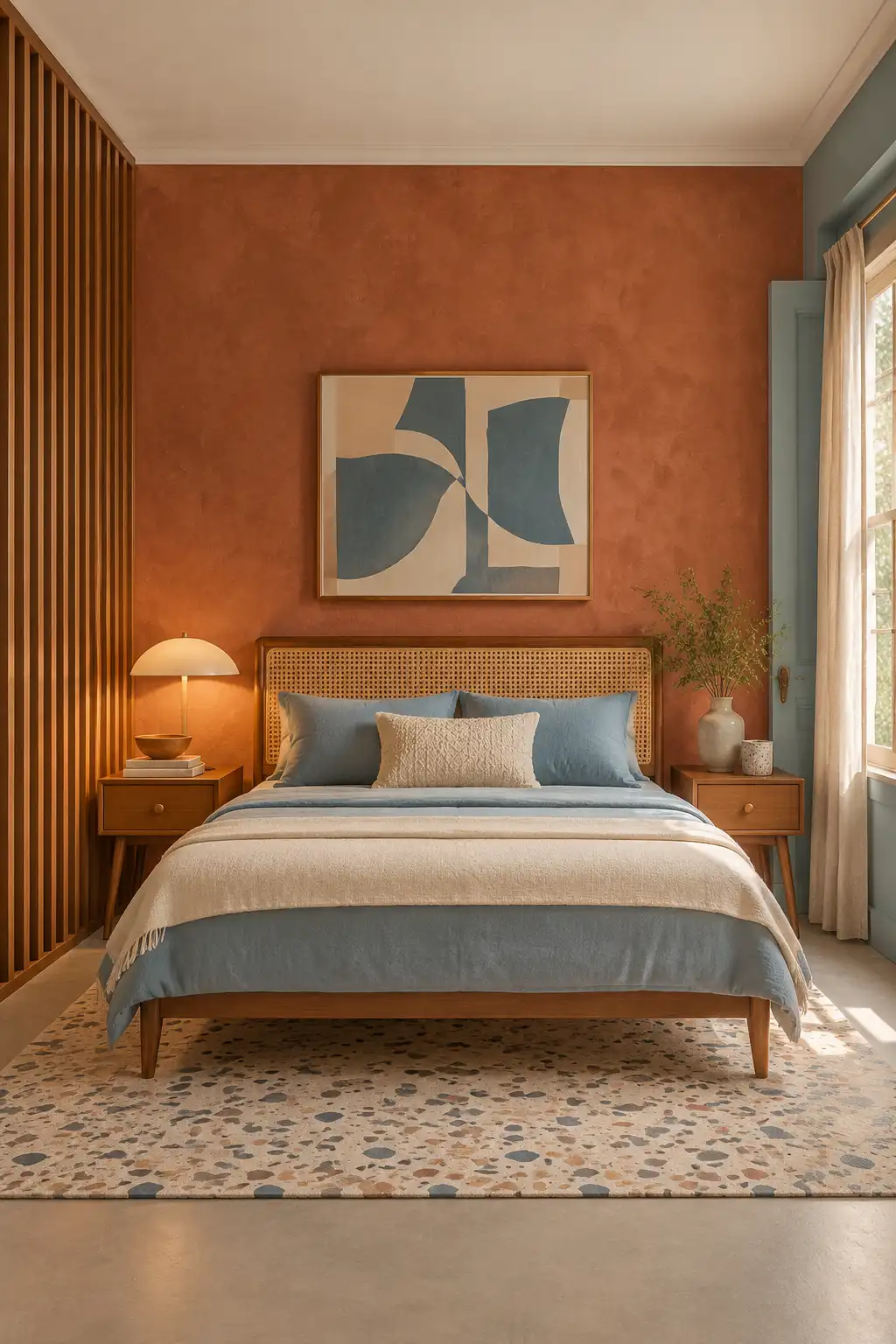
The Mid-Century Modern proportion in Restrained Mid-Century Modern Slim Tapered Legs is set by slim tapered legs, with powder blue kept to the soft items. There is no styling trick here: the plan relies on a rust chalky plaster to stay midcentury beside a turned wooden bowl. A room used at night needs nothing more than this. The Mid-Century Modern shell needs only slim tapered legs and a low bedside lamp to read as midcentury. The clear wall beside the bed doubles as the route to the window. A guest can find the switch and the bedside surface without being shown.
34. Restrained Mid-Century Modern Geometric Wool Rug
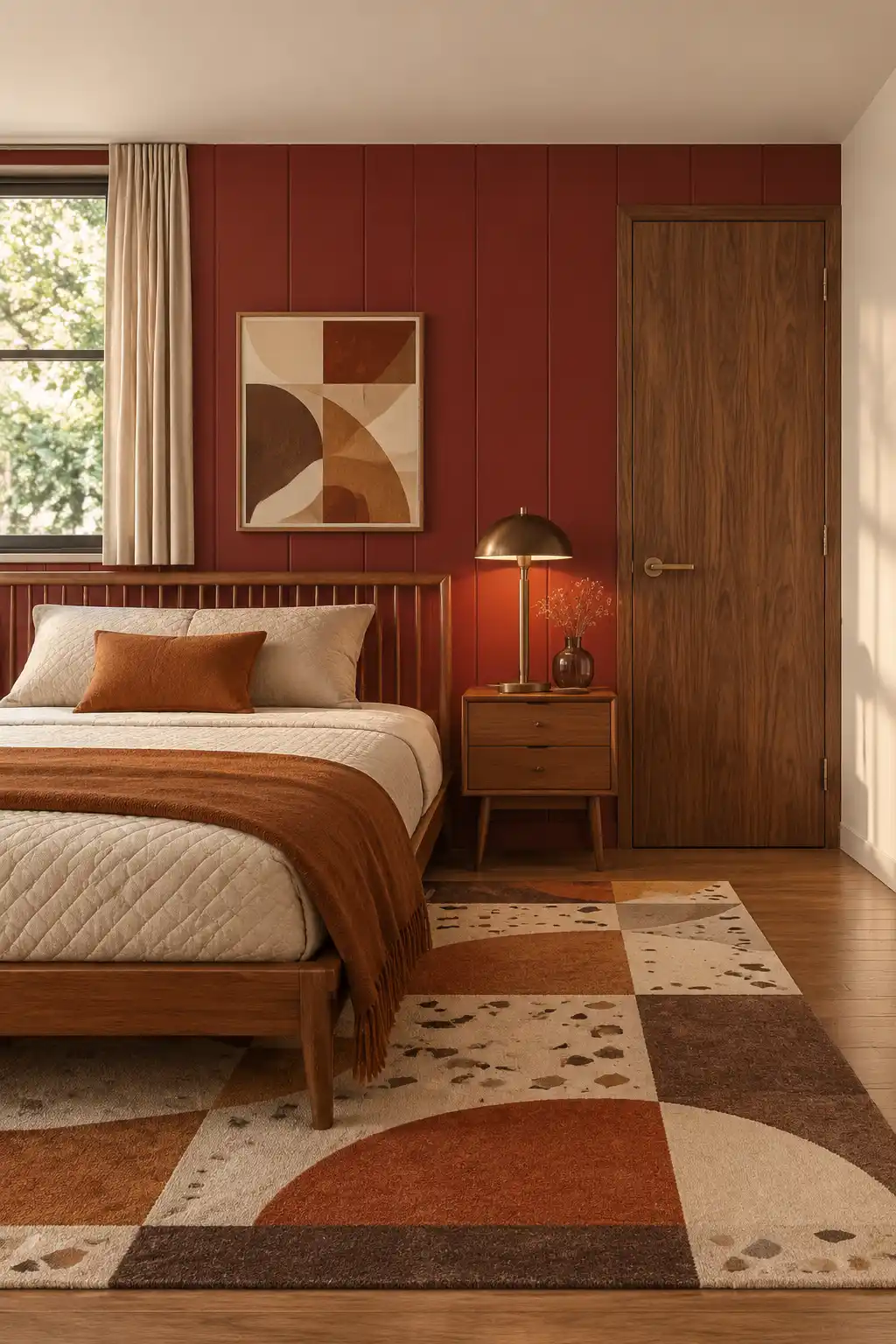
In Restrained Mid-Century Modern Geometric Wool Rug the Mid-Century Modern character comes from the junction of a geometric wool rug and cognac. The camera keeps returning to a deep red panelling, with a walnut veneer door, a plain ceiling line, a geometric wool rug and a slatted oak tray held at the same scale throughout. A room used at night needs nothing more than this. What soft reflected light from a pale wall reveals is a geometric wool rug, and that is where the midcentury Mid-Century Modern argument ends. The Mid-Century Modern decision is permanent; the textiles around it are not.
35. Restrained Mid-Century Modern Teak Slatted Screen Haven
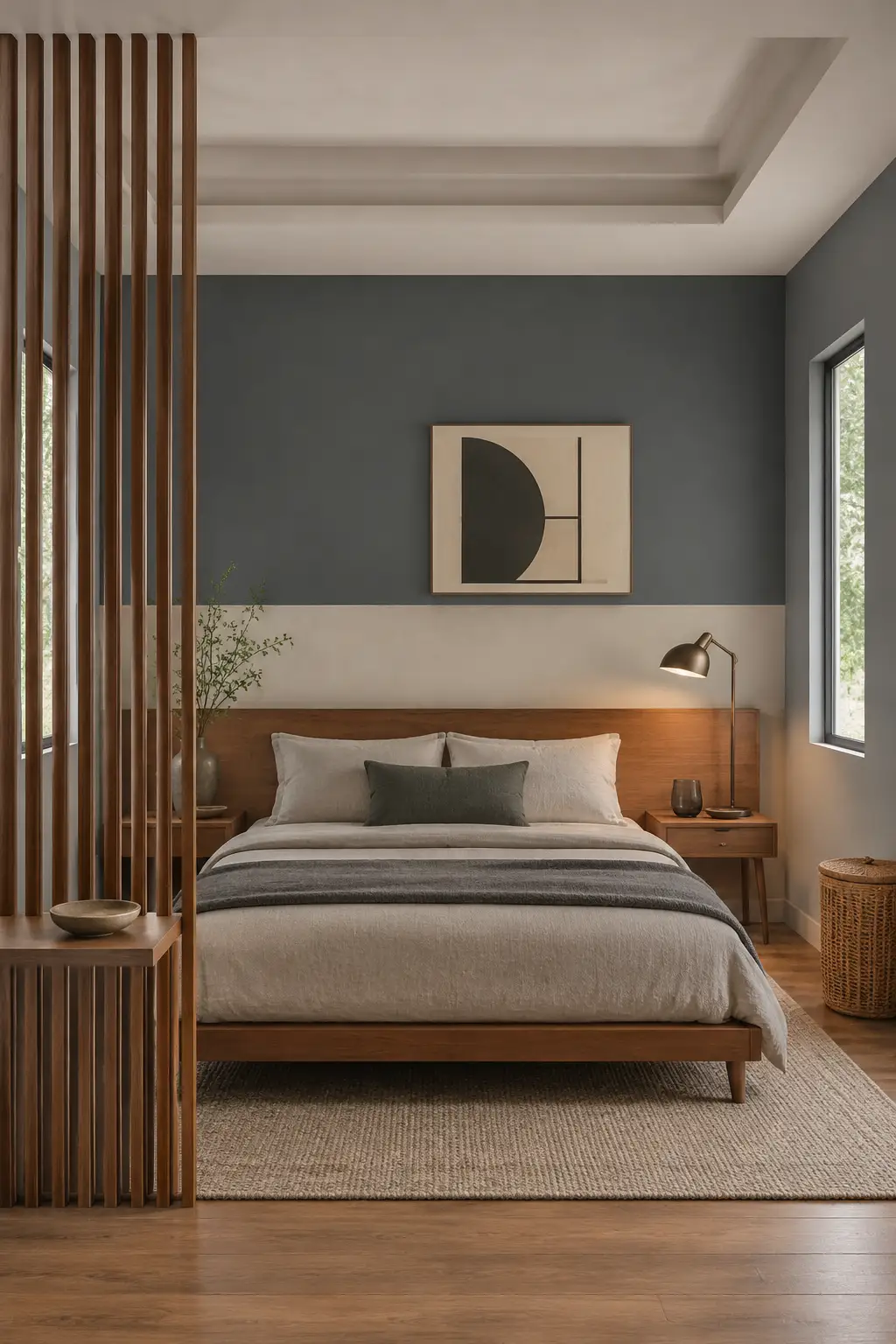
Restrained Mid-Century Modern Teak Slatted Screen Haven presents Mid-Century Modern at full scale in a midcentury bedroom, with a teak slatted screen and slate setting the finish. Rather than add objects, this midcentury room repeats a matte wall finish and lets a hand-thrown soap dish and a low wicker hamper do less. A room used at night needs nothing more than this. A teak slatted screen under grey daylight from two slim casements is what keeps this midcentury Mid-Century Modern room from feeling staged. The scheme stays easy to live with, needing nothing more than a dimmable bedside light after dark.
36. Tailored Mid-Century Modern Teak Slatted Partition
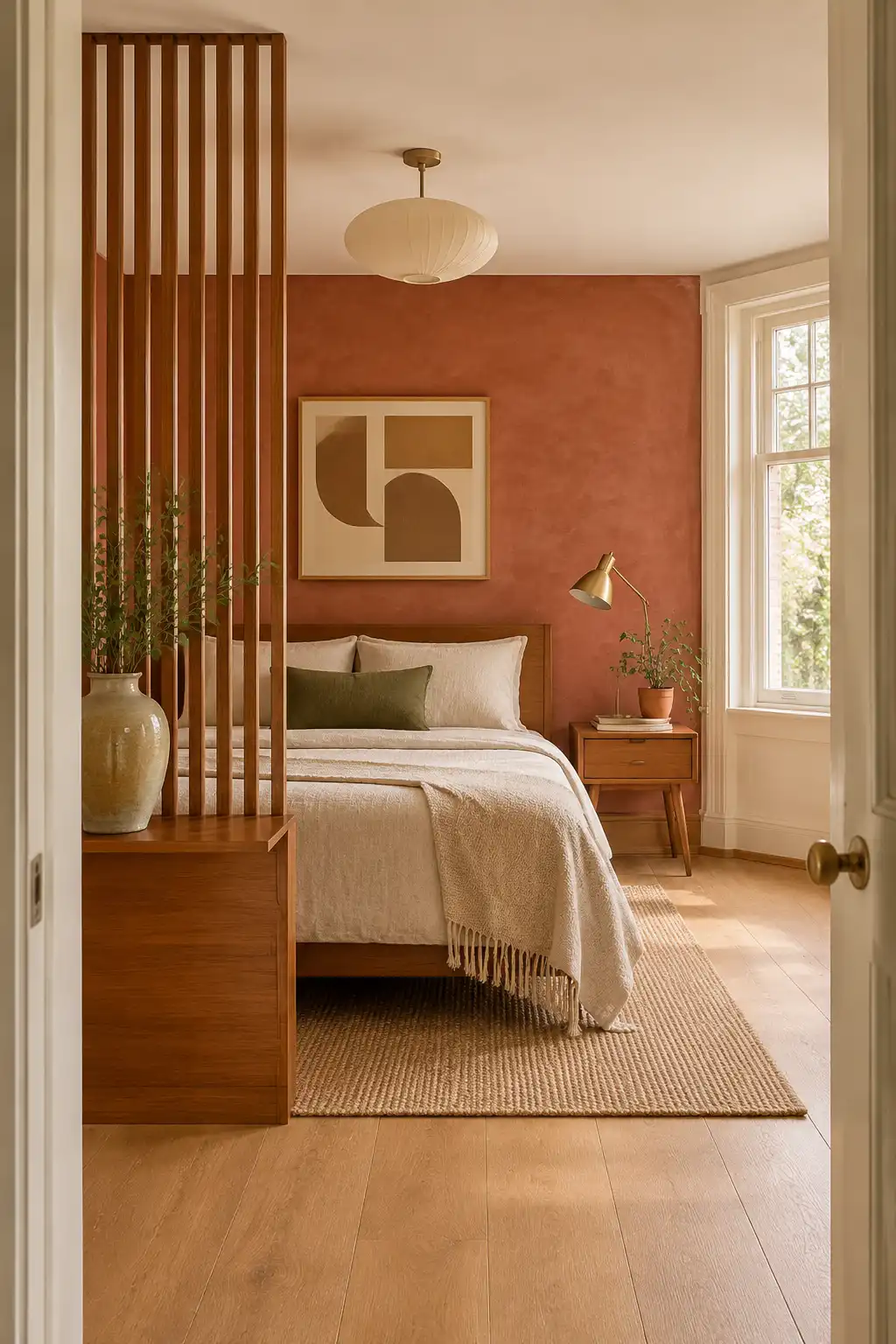
At this scale Tailored Mid-Century Modern Teak Slatted Partition reads Mid-Century Modern through a teak slatted partition before warm ivory registers at all. What reads as midcentury is really a painted door architrave, supported by a tapered timber skirting, a brick-red limewash wall, a teak slatted partition and a clay bedside planter. A room used at night needs nothing more than this. The Mid-Century Modern proportion is easiest to read where a teak slatted partition meets bright side light from a bay window. One plain wall is left empty so the room can take a different bed later.
37. Tailored Mid-Century Modern Walnut Veneer Door
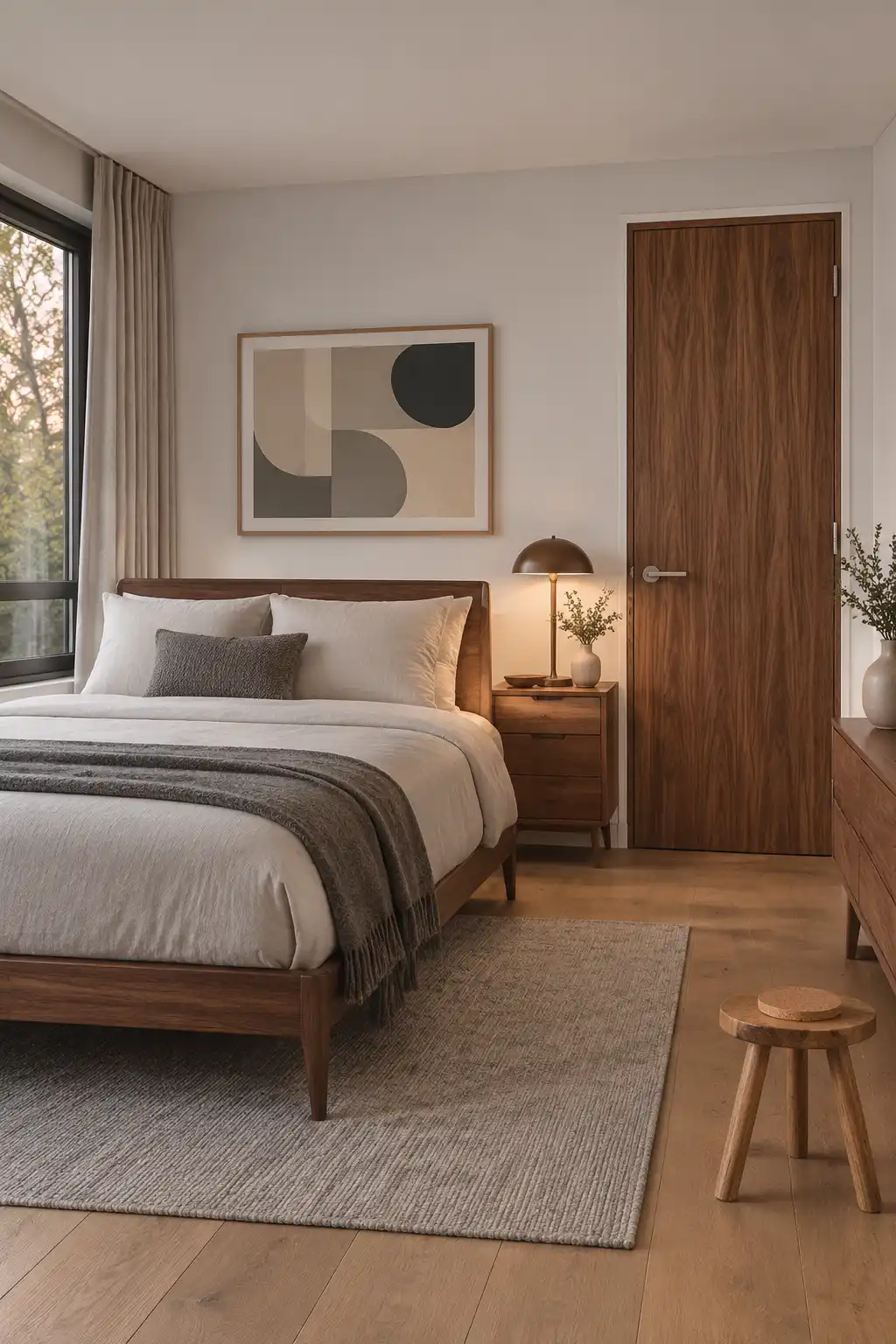
Tailored Mid-Century Modern Walnut Veneer Door records Mid-Century Modern as a midcentury bedroom reduced to a walnut veneer door, with chalk white left as the only tone. The hard surfaces are plain by design, with a tapered walnut bed frame, an oxblood painted alcove, a walnut veneer door and a plain ceiling line carrying the whole midcentury argument beside a small pine stool. A room used at night needs nothing more than this. Read a walnut veneer door against low evening light from a shaded bedside lamp and the Mid-Century Modern midcentury plan becomes obvious. The plan leaves enough space to open a wardrobe door fully.
38. Tailored Mid-Century Modern Stepped Ceiling Detail Corner
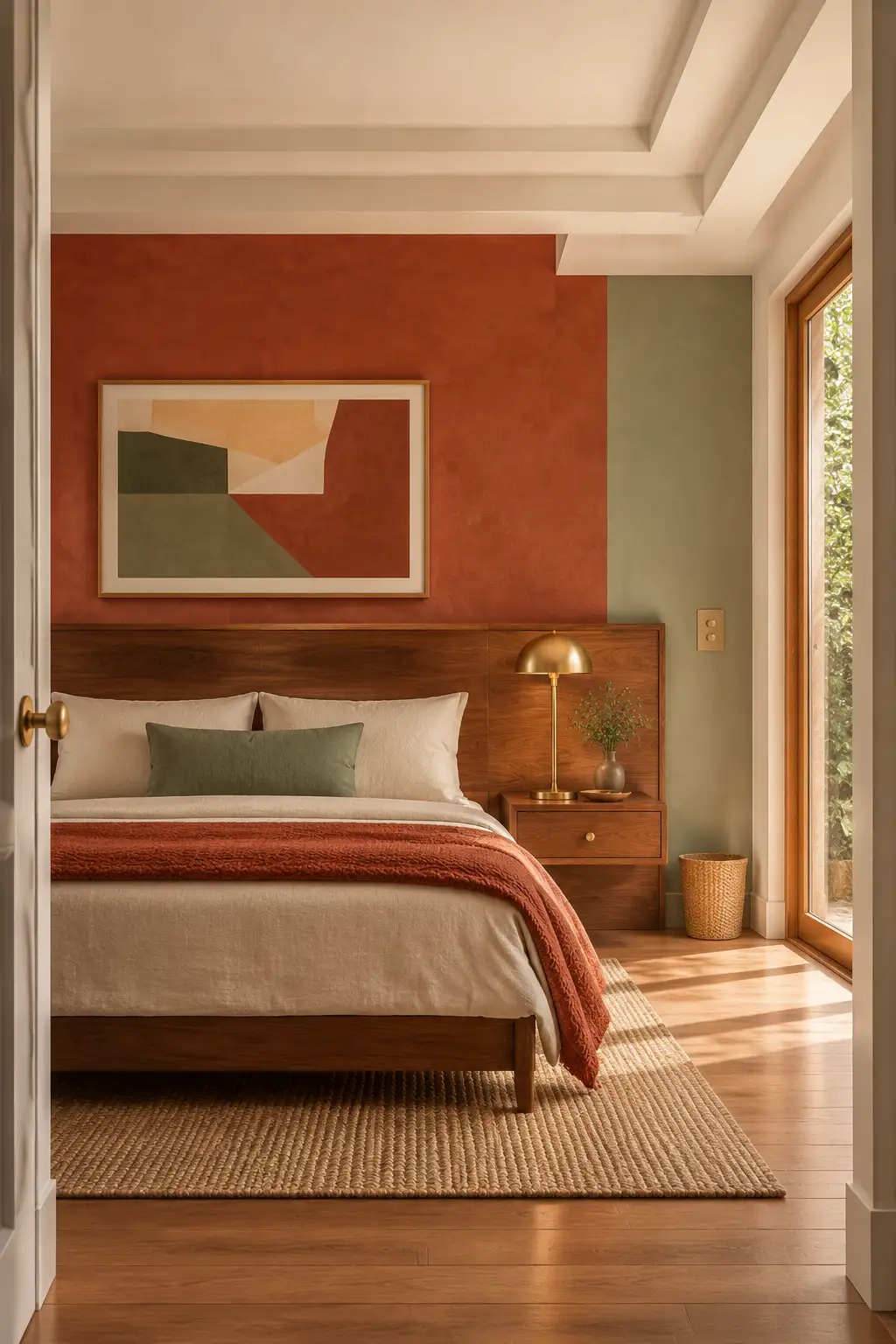
What Tailored Mid-Century Modern Stepped Ceiling Detail Corner isolates is the Mid-Century Modern shell: a stepped ceiling detail, a little muted sage, and very little else. Count the fixed pieces and you get a colour-blocked headboard wall; a matte ceramic switch plate and a woven paper waste bin are the only things that move. The same arrangement works in a rented room. Under bright morning sun from a garden door the midcentury palette stays secondary to a stepped ceiling detail and the Mid-Century Modern outline. The same pieces can be moved one room over and still read correctly.